Mondoo Release Highlights May 2026
Introduction
May is a milestone month for Mondoo. We're rolling out an all-new UI, redesigned from the ground up around the questions security teams care about most: Are we fixing the risks that matter, and are we improving? Leading the redesign is Risk Dimensions, a transparent scoring model that finally lets you explain a finding's risk in a single sentence. There's plenty more beyond the new UI, so let's dive in!
The All-New Mondoo App
The biggest news this month is a complete redesign of the Mondoo UI. This new app is built to answer the questions security teams actually ask: Are we fixing the risks that matter? Are we getting better? Rather than drowning you in finding counts, it leads with prioritization, remediation, and progress.
The interface is rebuilt on a new component framework with higher contrast, a denser information layout, and improved accessibility throughout. That foundation lets us ship features faster and sets the stage for the agentic workflows coming later this year.
You can switch to the new experience today. The previous console stays available during a soft migration period, so your team can move on its own timeline. On August 3, 2026, the new App becomes the only UI, and console.mondoo.com redirects to app.mondoo.com.
Risk Dimensions
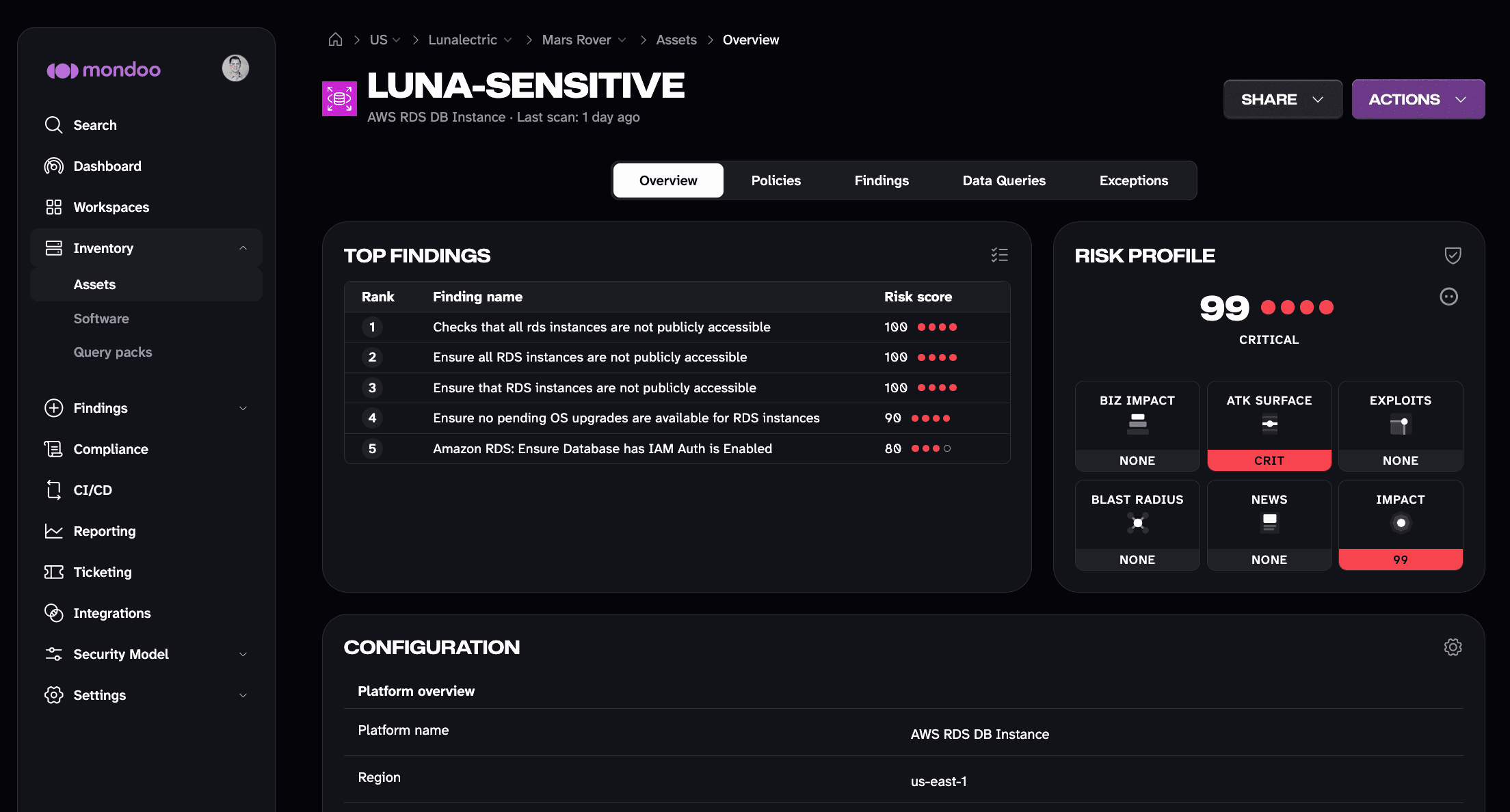
At the heart of the new UI are Risk Dimensions, a transparent scoring model that replaces the old single, opaque score. Instead of defending a number like 7.4 assembled from dozens of compounding factors, you get a risk score you can explain in a sentence: "This is high risk because it's internet-facing, on a business-critical asset, with an exploit in the wild."
Mondoo now evaluates every finding across five dimensions:
- Attack surface: How exposed the affected component is, from internet-facing down to no detected attack surface. The assessment is finding-specific, so a vulnerability in a module that isn't on the active attack path scores lower even on an internet-facing host.
- Blast radius: What an attacker reaches if the asset is compromised. A database, identity provider, LLM agent, or Kubernetes control plane weighs far more than an isolated workload.
- Business priority: How important the asset is to your organization. You set this with annotations, cloud tags, CMDB metadata, or CIA classifications, and it raises or lowers risk accordingly.
- Exploitability: Whether a vulnerability is theoretical or weaponized, combining EPSS probability and CISA's Known Exploited Vulnerabilities catalog. This separates "patch when convenient" from "patch tonight."
- News: Whether a CVE is trending across security media and social channels. When a vulnerability is trending, attackers are reading the same articles your defenders are.
Each dimension is rated None, Low, Medium, High, or Critical, and the defaults are sensible out of the box. When you need to tune them, you can adjust the weight of each dimension or disable one entirely at the organization level. To learn more, read Risk Dimensions and Configure Risk Dimensions.
Initiatives: Know What to Fix First
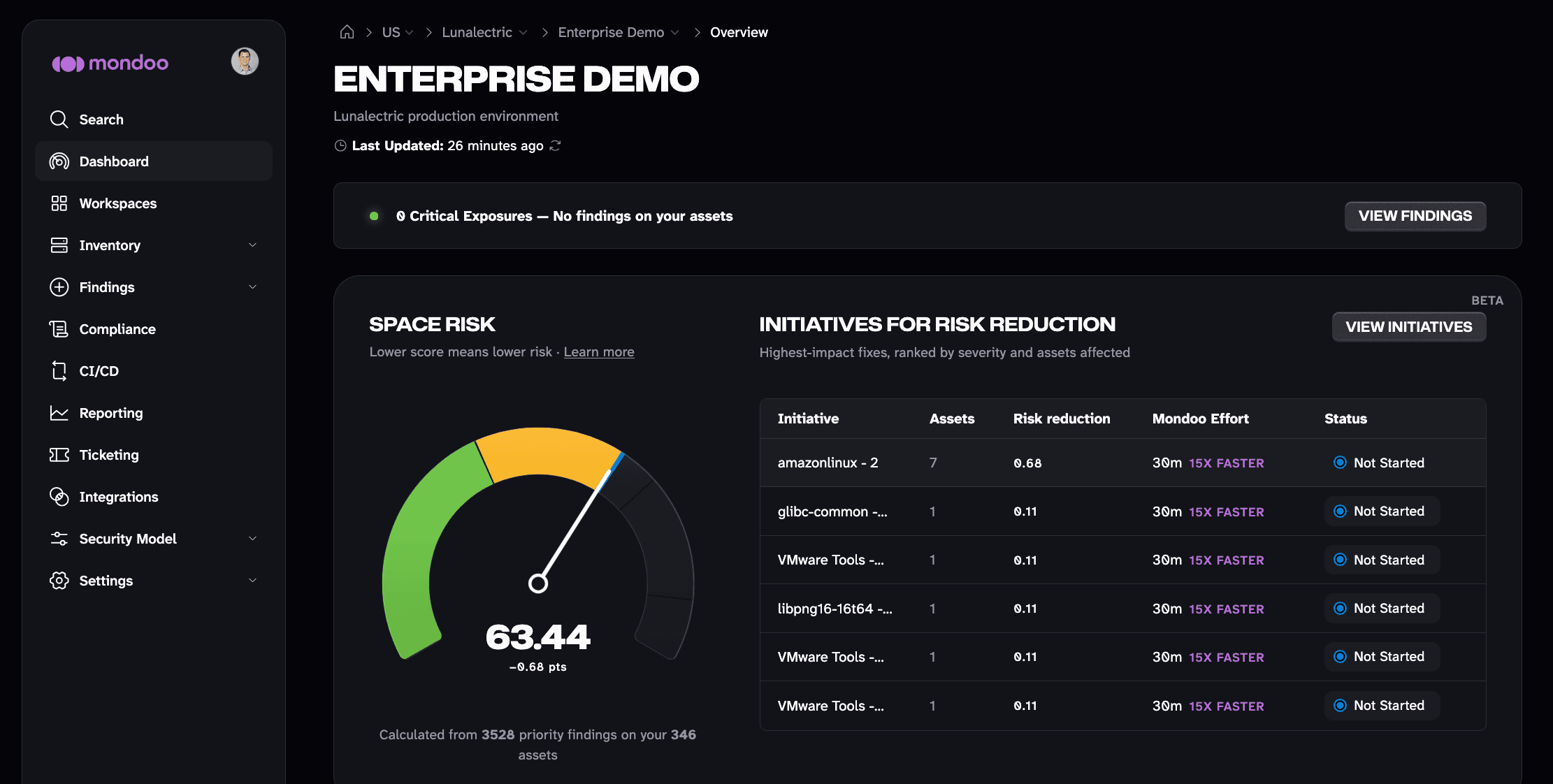
Prioritizing findings is only half the battle. Knowing which work to take on first, and how much risk it removes, is the other half. Mondoo now automatically identifies initiatives: focused efforts you can undertake to reduce the risk of your spaces.
An initiative groups related findings into a single, high-impact unit of work, so instead of staring at thousands of individual findings, you see the handful of efforts that move the needle most. Mondoo surfaces them automatically and ranks them by the risk they remove, so your team can work on the most important findings first.
Dive into any initiative to see the grouped findings, review the remediation guidance, and create tickets to get the work moving. It turns "where do we even start?" into a short, ordered list of the changes that matter most.
Remediation context where you need it
The new UI surfaces operational signals that decide how difficult a fix actually is, right alongside each finding instead of buried in separate documentation:
- Whether applying the fix requires a restart
- Whether a rollback path is available
- The risk of the patch or version bump itself
- The downstream services and dependencies a change would impact
Redesigned dashboards and executive reports
The organization dashboard was overhauled to show where risk is concentrated, how your posture is trending, and what to fix next. Executive reports were redesigned to communicate directly with leadership, answering "Are we fixing important risks, and are we improving?" without overwhelming anyone with raw statistics. See Executive reports for details.
Faster search and richer filters
Search is faster and more forgiving, filters are richer and combinable, and information-dense list rows mean fewer clicks to find what you're looking for across environments with tens of thousands of assets and hundreds of thousands of findings.
Track SLAs Your Way
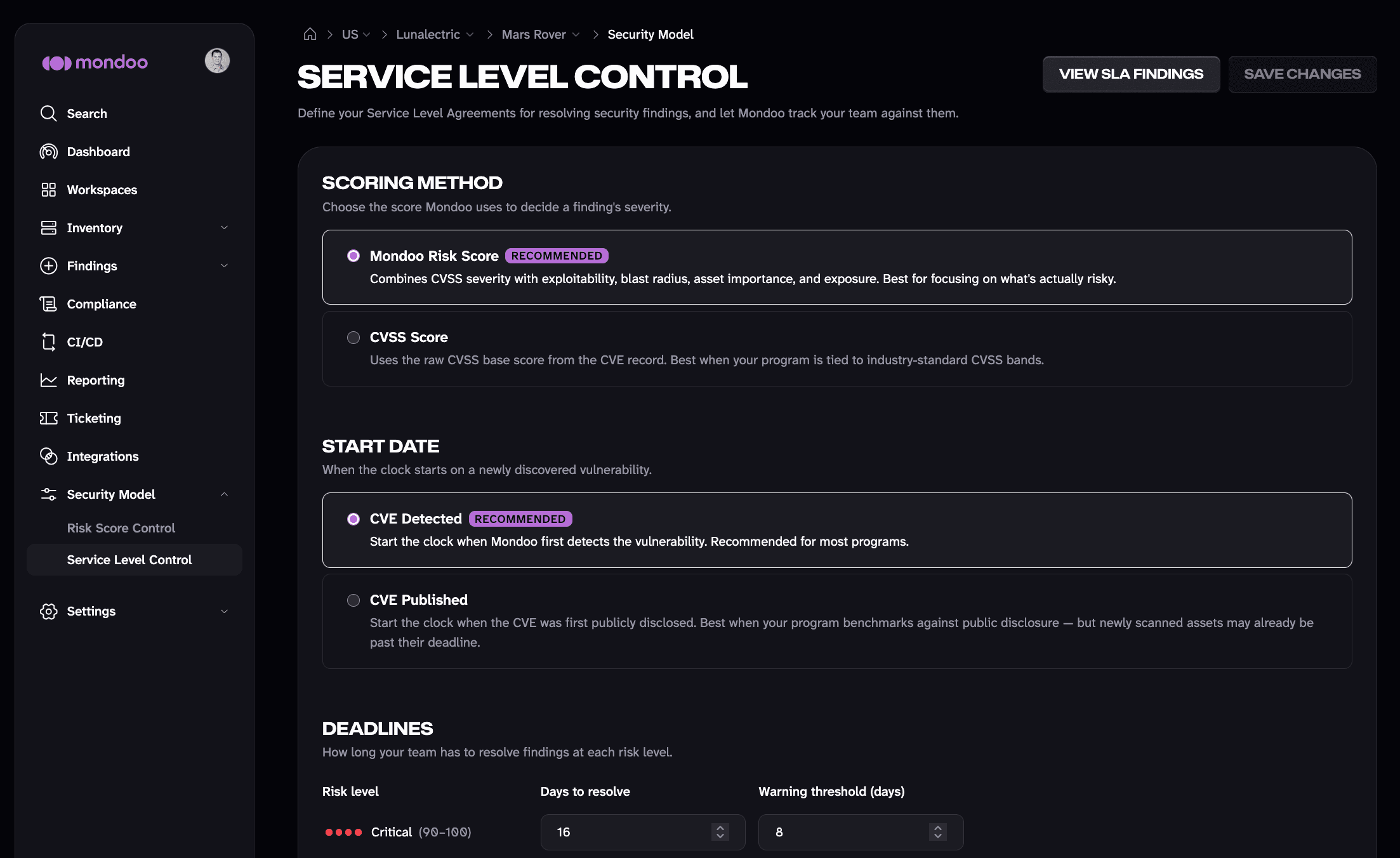
Every organization measures remediation deadlines differently. Some hold teams to the prioritized urgency that Mondoo calculates, while others are required to report against raw CVSS severity. Now you can choose.
Service-level agreements can be configured to score using either the Mondoo Risk Score, the prioritized score that factors in real-world asset context, or the CVSS score. Whichever your organization uses to define remediation deadlines, Mondoo measures your mean time to remediate against the right targets, so you can track SLA progress no matter how your team tracks SLA compliance.
New Integrations for Scanning Your Infrastructure
Connecting your infrastructure to Mondoo just got easier. This month adds five new integrations, extending continuous security assessment to more of your environment.
The new integrations span both cloud platforms and the network devices your infrastructure runs on:
- DigitalOcean: Scan your DigitalOcean account for misconfigurations across Droplets, Cloud Firewalls, Managed Databases, Load Balancers, Kubernetes (DOKS), Spaces, and more.
- Cloudflare: Continuously assess your Cloudflare configuration, including DNS and DNSSEC, WAF, R2 storage, email routing, and SSO.
- Arista EOS: Bring your Arista switches under continuous security assessment, checking administrative access, AAA, SSH, SNMP, NTP, and port security.
- F5 BIG-IP: Assess the security posture of your BIG-IP application delivery and load-balancing devices.
- Ubiquiti UniFi: Scan your UniFi network infrastructure for misconfigurations and hardening gaps.
Send Your Findings to Splunk and Elastic
Mondoo is most powerful when its findings live alongside the rest of your security telemetry. This month adds two new continuous data export destinations: Splunk and Elastic.
Point Mondoo at your Splunk or Elastic deployment and it streams assets, vulnerabilities, and scan results straight into the analytics systems your team already uses. Correlate Mondoo findings with the rest of your data, build custom dashboards, drive alerting, and feed your security data lake, all without exporting and importing by hand.
Take AI Security to the Next Level
April helped you find shadow AI across your fleet. May goes a level deeper: you can now scan the AI platforms and model services your teams actually use, bringing their configuration, access, and audit trails under the same security visibility as the rest of your environment.
New providers connect directly to the major AI platforms:
- Anthropic Claude: Audit your Claude organization end to end, covering workspaces and members, API keys, invites, and rate limits, plus usage, cost, and activity logs, agents, skills, files, and vaults.
- OpenAI: Inspect projects, API keys, and service accounts, organization users and invites, models, files, fine-tuning jobs, vector stores, and the audit log.
- Mistral: Review models, fine-tuning and batch jobs, and uploaded files.
- Hugging Face: Assess users, organizations, access tokens and their scopes, models, datasets, Spaces, webhooks, and inference endpoints.
- Ollama and Together AI: Surface the models, deployments, endpoints, and secrets running on your self-hosted and managed inference platforms.
- vLLM: Scanning now reports the models loaded for serving, so you can confirm exactly what each inference server exposes.
Together, these turn "which AI services do we use, and are they configured securely?" into a question you can answer with a single scan.
May also brings vulnerability detection to the AI tools spreading across developer machines. Mondoo now scans Claude Code, Claude Desktop, Cursor, Windsurf, Kiro IDE, and Roo Code for known vulnerabilities across macOS, Windows, and Debian and Ubuntu Linux. Shadow AI is no longer just something you can find; it's something you can keep patched.
To tie it all together, cnspec can now generate an AI Bill of Materials (AIBOM). The new cnspec aibom command inventories your AI supply chain, including models, agents, skills, MCP servers, guardrails, and knowledge bases, and exports it as a standard CycloneDX ML-BOM. Just as a software bill of materials captures what goes into a build, an AIBOM gives you a portable, shareable record of every AI component your environment depends on.
Secure the Code That Builds Production
April brought Bicep, Helm, and Kustomize scanning. May pushes infrastructure as code coverage deeper still, headlined by a ground-up rebuild of the Bicep provider.
Complete Bicep language coverage
Bicep scanning was rebuilt from the ground up to give you complete coverage of the Bicep language. Whatever a Bicep file can express, you can now write policy against:
- Full language constructs: User-defined types and functions, import statements with cross-file type and function resolution, and
.bicepparamparameter files. - Reference resolution: A new expression engine resolves references between parameters, variables, resources, modules, and types, so you can follow how a value is actually built instead of matching raw strings.
- Loops everywhere:
forloops are now modeled on resources, modules, variables, and outputs. - Parameter constraints: Parameters expose their
minLength,maxLength,minValue, andmaxValuevalidation, ideal for hardening credential and sizing inputs. - Richer resources: Resources surface tags, nested child resources, and deployment scope.
- Compiled ARM detail: The compiled ARM output adds full
copyloop details (name, count, mode, and batch size), deployment conditions, and linked templates.
Expanded CloudFormation coverage
CloudFormation scanning now reads more of what each template declares: parameters, output values with their export names and gating conditions, and the resource lifecycle policies that protect your data. New deletionPolicy and updateReplacePolicy fields let you confirm stateful resources won't be destroyed on stack deletion or replacement, while creationPolicy and updatePolicy expose rollout behavior. That makes it easy to flag templates that risk data loss or leak sensitive values through stack outputs.
Broader Terraform policy coverage
Mondoo has long scanned Terraform, and this month we extended that coverage to even more of our security policies. New Terraform variants this month span AWS, GCP, OCI, Cloudflare, DigitalOcean, Snowflake, GitHub, GitLab, Tailscale, UniFi, Microsoft 365, and VMware vSphere, each with Terraform-specific remediation. The more policies that understand your IaC, the more security concerns you catch in the code that builds your infrastructure, instead of letting them slip into production.
A much bigger Helm provider
The Helm provider received a large expansion with all-new capabilities for auditing charts before they ever reach a cluster:
- Dependencies and subcharts: Walk the full dependency tree through subcharts and parents, with each dependency's source type, resolved version, and OCI registry reference, plus the
Chart.lockfile, so you can audit the exact versions a chart pulls in for offline supply chain review. - CRDs: Inspect the CustomResourceDefinitions a chart introduces, separately from its normally rendered resources.
- Hooks: Surface lifecycle hooks, often privileged jobs, with their types, weights, and delete policies, without scanning every rendered manifest.
- Linting and schema: Read
helm lintresults and messages, the chart's values JSON schema, itsNOTES.txtoutput, annotations, and thekubeVersionconstraint.
Together these give you a complete picture of what a chart installs and pulls in, so you can enforce policy on dependencies, CRDs, and privileged hooks before deployment.
Kustomize patch inspection
Kustomize scanning can now break a patch down into its individual operations. A new operations field exposes each add, replace, or remove in a patch, along with the patch format, so you can catch overlays that strip a security control, such as an op: remove targeting a container's securityContext, before they reach a cluster.
Richer Dockerfile analysis
Mondoo's Dockerfile scanning now understands more of the instructions that shape your container builds:
RUN --mount: Inspect the mounts used during build steps, so you can catch secrets or sensitive host paths exposed to aRUNinstruction.STOPSIGNAL: Check the signal used to stop the container, so shutdown behavior matches what you expect.ONBUILD: See the triggers a base image fires in downstream builds, a common place for surprising or risky behavior to hide.
With these, you can write and enforce policy against more of your Dockerfiles before an image is ever built.
Deeper Ansible auditing
Ansible scanning goes deeper into your playbooks too. New fields on plays and tasks expose privilege escalation (become, becomeUser, becomeMethod, and becomeFlags), secret-handling hygiene (noLog), error handling (ignoreErrors), and task flow control (tags, loop, loopControl, delegateTo, runOnce, and environment). That lets you catch tasks that escalate privileges, suppress logging, or ignore failures in ways your standards don't allow, before a playbook ever runs.
Secure Your MDM Deployments with Jamf
Mobile device management is where your fleet's security posture is actually enforced, so it deserves the same scrutiny as the rest of your infrastructure. May adds a brand-new Jamf provider, bringing your Apple device management under Mondoo's eye.
Connect Mondoo to Jamf Pro and you can inspect enrolled computers and computer groups, local user accounts, Jamf users and SSO settings, and the packages deployed across your fleet. That gives you a way to confirm your managed Mac estate is configured the way your policies require, that single sign-on is set up securely, and that only the software you expect is reaching your endpoints.
Expanded On-Prem Security
Your on-prem and private cloud infrastructure deserves the same depth of coverage as the hyperscalers. This month Mondoo goes much deeper across OpenStack, VMware vSphere, and Proxmox VE.
OpenStack
Mondoo's OpenStack coverage took a big step forward this month, with a much deeper provider and an all-new Mondoo OpenStack Security policy.
The OpenStack provider now reaches far more of your private cloud. New resources cover Swift object storage (accounts, containers, and objects), Designate DNS zones and recordsets, Nova hypervisors, compute services, host aggregates, and per-project limits, Cinder volume types, backups, and quotas, Neutron network quotas, Glance image sharing members, Keystone application credentials and groups, and Barbican key manager ACLs. That gives you the visibility to audit storage exposure, quota sprawl, credential hygiene, and secret access controls across every project in your OpenStack deployment.
An all-new Mondoo OpenStack Security policy ships alongside the provider with 14 checks, turning this new visibility into automated hardening across access control, network exposure, storage, encryption, and key management.
VMware vSphere and ESXi
The vSphere provider gained broad new coverage across vCenter, ESXi hosts, and virtual machines:
- Access control: vCenter RBAC roles and permission grants, SSO identity sources, inventory folders, and resource pools.
- Host hardening: lockdown mode, host firewall rulesets, UEFI Secure Boot status, installed VIBs, kernel modules, running services, NTP and time zone configuration, iSCSI adapters, and host certificates.
- VM security: boot firmware and Secure Boot, Virtualization-Based Security, virtual TPM, VM encryption and the KMS clusters backing it, snapshots, attached CD-ROMs, network adapters, and CPU and memory allocation.
- Network security: standard vSwitch and port group security policies (promiscuous mode, MAC address changes, and forged transmits), failover and traffic-shaping policies, and datastore details.
Proxmox VE
The Proxmox VE provider expanded just as dramatically across the cluster, nodes, VMs, and containers:
- Access control: users, groups, ACLs, and authentication realms (PAM, PVE, LDAP, AD, OpenID), plus API token ownership and two-factor enrollment and lockout state.
- Firewall: cluster-, node-, and VM-level firewall options, IPsets, aliases, groups, and rules.
- Guests: LXC container configuration, mount points, and passthrough devices, plus VM cloud-init settings (default user, injected SSH keys, and password state), serial ports, and PCI and USB passthrough.
- Storage and resilience: ZFS pools, LVM volume and thin pools, disk SMART health, storage encryption, high-availability groups, backup jobs, replication jobs, and software-defined networking zones, vNets, and subnets.
- Node hardening: UEFI Secure Boot, pending-reboot detection, CPU mitigation flags, and node certificates.
Mondoo's VMware vSphere and ESXi security policies are now open source, and they've roughly doubled in size by taking advantage of the new provider capabilities, reaching 44 checks for vCenter, cluster, and VM configuration and 29 checks for ESXi host hardening. On the Proxmox side, the new coverage is provider-side this month, and the Proxmox VE Security policy now includes full descriptions and remediation instructions for every check, so each finding tells you exactly what's wrong and how to fix it.
Secure Critical Linux Services
The services running on your Linux hosts decide how traffic is routed, proxied, logged, and served. May adds native configuration parsing for five of the most common ones, so you can write policy against their actual settings instead of grepping config files:
- HAProxy: Parse the full HAProxy configuration, including the global and defaults sections, frontends, backends, listen sections, binds, servers, resolvers, userlists, and peers. Audit how your load balancer terminates TLS, routes traffic, and authenticates.
- Squid: Inspect the Squid proxy configuration, covering listen directives, ACLs, access rules, cache peers, cache directories, refresh patterns, and access logs.
- Apache HTTP Server: New virtual host and
<Location>coverage, plus information-disclosure controls (ServerTokens,ServerSignature, andTraceEnable), response security headers, and per-directoryRequirerules. - nginx: New server blocks and upstreams, plus richer location parsing for modifiers,
try_files,return, andfastcgi_pass. - rsyslog: Examine loaded modules, configured inputs, output actions, and routing rules, so you can confirm logs are shipped where they belong.
For example, confirm Apache isn't leaking version details or honoring trace requests:
MQLapache2.conf {serverTokens == "Prod"serverSignature == "Off"traceEnable == "off"}
Simpler Kubernetes Querying
The Kubernetes provider was reworked from the ground up to make authoring and reading queries against your workloads easier than ever. Workload types like Deployments, DaemonSets, and StatefulSets were always resources, but inspecting their configuration used to mean navigating raw JSON. Now every setting you care about is a native, documented field.
What that means in practice:
- Native fields instead of JSON navigation. The settings buried in a workload's spec and status are now first-class fields you can name directly: replica counts, rollout strategies, schedules, selectors, and status conditions on Deployments, DaemonSets, StatefulSets, ReplicaSets, Jobs, and CronJobs; Pod scheduling and security settings (
hostNetwork,hostPID,securityContext,serviceAccount,tolerations, andaffinity); Service networking (type,clusterIP,loadBalancerSourceRanges, andports); and NetworkPolicy rules. Your queries read like the concepts they describe instead of indexing into maps. - New subresources. Container statuses, HorizontalPodAutoscalers, PersistentVolumes, and PersistentVolumeClaims are now queryable, along with the Kubernetes Gateway API (GatewayClasses, Gateways, HTTPRoutes, GRPCRoutes, and ReferenceGrants), PodDisruptionBudgets, Leases, CertificateSigningRequests, APIServices, and IngressClasses.
- Relationships you can traverse. Pods link back to the Deployment, ReplicaSet, StatefulSet, DaemonSet, or Job that owns them. Namespaces expose every workload they contain. Services resolve their EndpointSlices, Secrets and ConfigMaps list the Pods that use them, and RBAC roles surface the bindings that reference them, with no manual joins.
- Documentation built in. Every new field ships with inline documentation, so the Mondoo shell and the website tell you exactly what's available and what it means as you write a query.
The result: writing a check against your cluster is now closer to describing what you want than wrangling YAML.
Expanded Cloud Coverage
Cloud coverage went deeper across every major provider this month. Across AWS, Azure, GCP, OCI, and DigitalOcean, Mondoo added 388 new MQL resources and 1,226 new fields, so more of your environment is evaluated the moment you connect it and there's more you can write your own checks against. Each provider also reached a broad set of new services.
Finer-grained cloud discovery
Mondoo increasingly discovers individual cloud resources as their own assets rather than rolling everything up under the account. That granularity pays off in three ways: risk is easier to understand when each asset carries its own score, query output is cleaner and more targeted, and you can open tickets and create exceptions on a single finding instead of the entire account. This month adds fine-grained discovery for:
- AWS: ECR repositories, ECS task definitions, MQ brokers, MSK clusters, Route 53 hosted zones, and SageMaker processing and training jobs.
- Azure: Application Gateways, Container Apps, Firewalls, and Function Apps.
- GCP: Artifact Registry repositories, Memcached and Memorystore instances, and Vertex AI jobs.
- OCI: API Gateway deployments, Load Balancers, Redis clusters, Vault secrets, and OKE clusters.
Scan every AWS account from one integration
Onboarding AWS at scale just got dramatically simpler. Mondoo now supports cross-account scanning: set up a single Mondoo serverless integration in one main AWS account, and it scans dozens, hundreds, or even thousands of other accounts, with nothing to deploy in any of them. No per-account stacks and no repetitive setup, just connect once and cover your entire organization. See AWS cross-account scanning to get started.
AWS (155 new resources, 652 new fields)
New service coverage includes Macie, Firewall Manager, Bedrock, App Runner, API Gateway (v1 and v2), Glue, EventBridge, AppStream, Lake Formation, Detective, CloudHSM, Cognito, Database Migration Service, Storage Gateway, AppSync, and the developer tools CodePipeline, CodeArtifact, and CodeBuild.
Azure (115 new resources, 199 new fields)
New service coverage spans networking, Event Hubs and Event Grid, Cosmos DB, Cognitive Services, Microsoft Sentinel, Data Factory, Purview, Machine Learning, Logic Apps, and Cognitive Search.
GCP (79 new resources, 294 new fields)
New service coverage includes networking, Sensitive Data Protection (DLP), Certificate Manager, the Healthcare API, Dataplex, Cloud Workstations, Cloud Composer, Vertex AI and Workbench notebooks, and Binary Authorization.
OCI (29 new resources, 44 new fields)
New service coverage centers on Data Safe (database security and user assessments, sensitive data discovery, and masking policies), the Vulnerability Scanning Service (host and container scan recipes and results, CIS benchmark and endpoint-protection checks), and expanded Identity (database, SMTP, and OAuth2 credentials, dynamic groups, identity providers, network sources, and authentication policy).
DigitalOcean (9 new resources, 25 new fields)
New service coverage includes the Container Registry, Functions, Spaces object storage, snapshots, images, and Managed Databases.
The Mondoo cloud security policies grew alongside the providers. The AWS Security policy added 39 new checks spanning Bedrock, WAF, Batch, Step Functions, Private CA, Lightsail, API Gateway v2, Glue, Athena, EventBridge, CloudFront, DMS, Secrets Manager, and more. The Azure Security policy added 4 new checks for Container Apps and Container Instances.
New SaaS Security Capabilities
SaaS platforms gained substantial new depth this month, reaching the configuration and access details that matter most for audits and least-privilege reviews:
- Microsoft 365: The month's largest SaaS expansion. New coverage spans Intune device management (compliance policies, configuration profiles, enrollment restrictions, and app inventory), Privileged Identity Management, conditional access named locations, OAuth permission grants, Defender XDR alerts and incidents, service principal credentials, and per-user sign-in activity and password policies.
- GitLab: Deep new supply chain and governance coverage, including approval rules, CODEOWNERS, runners, project and group vulnerabilities, the container registry with its protection and retention policies, and the package registry, plus richer user fields like admin and auditor roles and sign-in activity.
- Atlassian: Deep new Jira and Confluence auditing. Jira coverage adds projects with their roles, leads, components, and versions, plus custom fields, workflows, saved filters, dashboards, users (email, status, time zone, and locale), and issue details like components, fix versions, security levels, and vote and watcher counts. Confluence adds page versions, labels, and authorship, plus space homepages and creators. At the org level, new managed-user API token and organization policy resources round out the picture.
- GitHub: New visibility into Copilot Business seats, outside collaborators, GitHub Pages, and repository security settings like private vulnerability reporting.
- Google Workspace: New endpoint (device) management coverage, plus richer user identity data including SSH keys, POSIX accounts, emails, phones, external IDs, and role privileges.
- Okta: Coverage for external identity providers and custom OAuth 2.0 authorization servers, including their policies, rules, scopes, claims, and keys.
- Snowflake: New resource monitors, authentication and masking policies, policy references, and managed secrets.
- Tailscale: Auth keys, webhooks, and audit and flow log streaming, so you can confirm your tailnet is exporting logs to your SIEM.
These expansions come with policy updates too. A new Atlassian Security policy ships with 7 checks, and a new Shodan policy adds 3. The Microsoft 365 Security policy gained 5 new checks (unified audit logging, blocking automatic external email forwarding, restricting user app consent, managing privileged roles with Privileged Identity Management, and publishing DMARC records), and the Tailscale Security policy added 4 (pre-auth key expiration, non-reusable pre-auth keys, configuration audit log export, and HTTPS webhook endpoints).
Updated CIS Benchmarks
Staying current with CIS guidance keeps your infrastructure hardened against the threats that matter today. This month brings the CIS Google Cloud Platform Foundation Benchmark up to v5.0.0 (from v4.0.0).
New Compliance Frameworks and Mappings
Mondoo now ships the BSI C5:2026 framework, the latest edition of Germany's Cloud Computing Compliance Criteria Catalogue, giving teams in scope a ready-to-use mapping with no manual cross-referencing. It comes with a BSI C5:2026 to ISO/IEC 27001:2022 mapping, so every control you satisfy under one standard shows its equivalent under the other.
Vulnerability Detection Improvements
Smarter Windows patch remediation
Windows servicing is a web of cumulative updates, each one superseding the last. Mondoo now models that supersedence chain end to end, using WSUS supersedence digests as the authoritative source for which update replaces which. The payoff is precise, actionable remediation: instead of a list of overlapping KBs, Mondoo points you to the single latest cumulative update that resolves the most vulnerabilities, and findings reflect each system's true patch state once superseded updates are accounted for. The same chain awareness now extends to .NET cumulative updates and hotpatched systems.
And There's Even More
Beyond the highlights above, May brought a long list of smaller improvements throughout the product, too many to call out individually. And we're already hard at work on what's next, so look for more new functionality next month.