Scan Endpoints Managed by Action1
Run agentless cnspec fleet scans on the Windows, macOS, and Linux endpoints that Action1 manages.
The Action1 integration scans the Windows, macOS, and Linux endpoints that Action1 manages, without installing anything on them yourself. Mondoo uses the Action1 API to run a script automation on the endpoints of the endpoint group you choose. The Action1 agent runs the script, the script runs cnspec, and cnspec reports the results to Mondoo. To learn how fleet scans work, read Scan Endpoints Through Your Endpoint Management Tool.
Before you begin
You need the Editor or Owner role, or another role with this permission. To see every role, read Roles and permissions.
- Permission to create and view credentials in the Mondoo space. An Action1 integration keeps its API credential in the space's credentials.
- An Action1 account that Action1 support has verified. Until Action1 verifies an account, it refuses to run custom scripts, and Mondoo's scans are custom scripts.
- Endpoints with the Action1 agent installed, organized in Action1 endpoint groups
Action1 tenants where Endpoint Takeover Prevention enforces signed automations can't run fleet scans.
Create an Action1 API credential
-
In the Action1 console, open Users, then API credentials.
-
Create an API credential for Mondoo. Its role must be allowed to view endpoints and to run automations.
-
Copy the client ID and client secret. You need them in the next section.
Add an Action1 integration
In the Mondoo App, navigate to the space where you want to add the integration. In the side navigation bar, select Integrations. In the top right, select INSTALL. On the Install Integration page, find the integration you want by browsing a category or searching by name:
-
Under Endpoint Management / UEM, select Action1.
-
Prepare Action1 summarizes the API credential requirements above. To open the Action1 console for the selected region, select Go to Action1 console.
-
In Choose an integration name, enter a name that helps you identify the integration.
-
In Choose the Action1 organization, select the Region of the Action1 console you sign in to:
- North America (
app.action1.com) - North America 2 (
app.na-2.action1.com) - Europe (
app.eu.action1.com) - United Kingdom (
app.uk.action1.com) - Australia (
app.au.action1.com)
One integration scans one Action1 organization. If you enter a new API credential, you can leave the organization empty: Mondoo looks up the organization the credential can see when it creates the integration. If the credential can see more than one organization, choose one under Organization, or select Enter the ID instead and enter the Organization ID. To scan more organizations, add an integration for each one.
- North America (
-
In Choose which endpoints become assets, choose what Import endpoints as assets does:
- Endpoints of scanned host groups (the default): When a fleet scan starts, the endpoints of its endpoint group become assets in the space, including the ones the scan doesn't reach. macOS endpoints aren't imported; they become assets when a scan reports them.
- Off: Each endpoint becomes an asset only when a scan reports it.
-
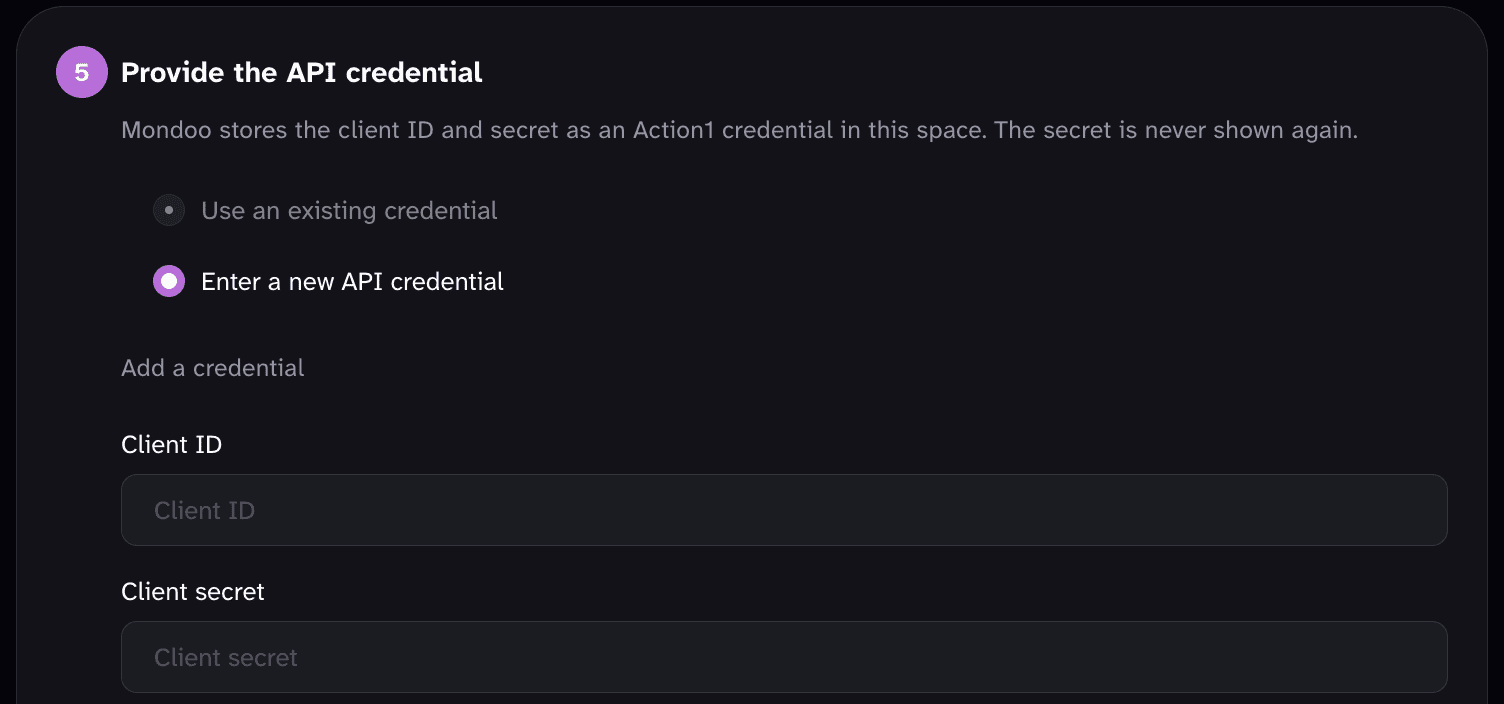
In Provide the API credential, choose where the credential comes from:
- To reuse an Action1 credential stored in the space, select Use an existing credential and choose it under Credential. The region comes from the credential.
- Otherwise, select Enter a new API credential and enter the Client ID and Client secret you copied. Mondoo stores them as an Action1 credential in the space and never shows the secret again.
-
Select Create Integration.
Next, choose the endpoint group to scan and a schedule, as described below. To start a scan now for every endpoint group with an active schedule, select Run on the integration's page.
Run and schedule fleet scans
To open the integration, navigate to the space, select Integrations in the side navigation, choose the integration type, then select the integration. Then select the Scan Jobs tab.
In the Run a fleet scan card:
-
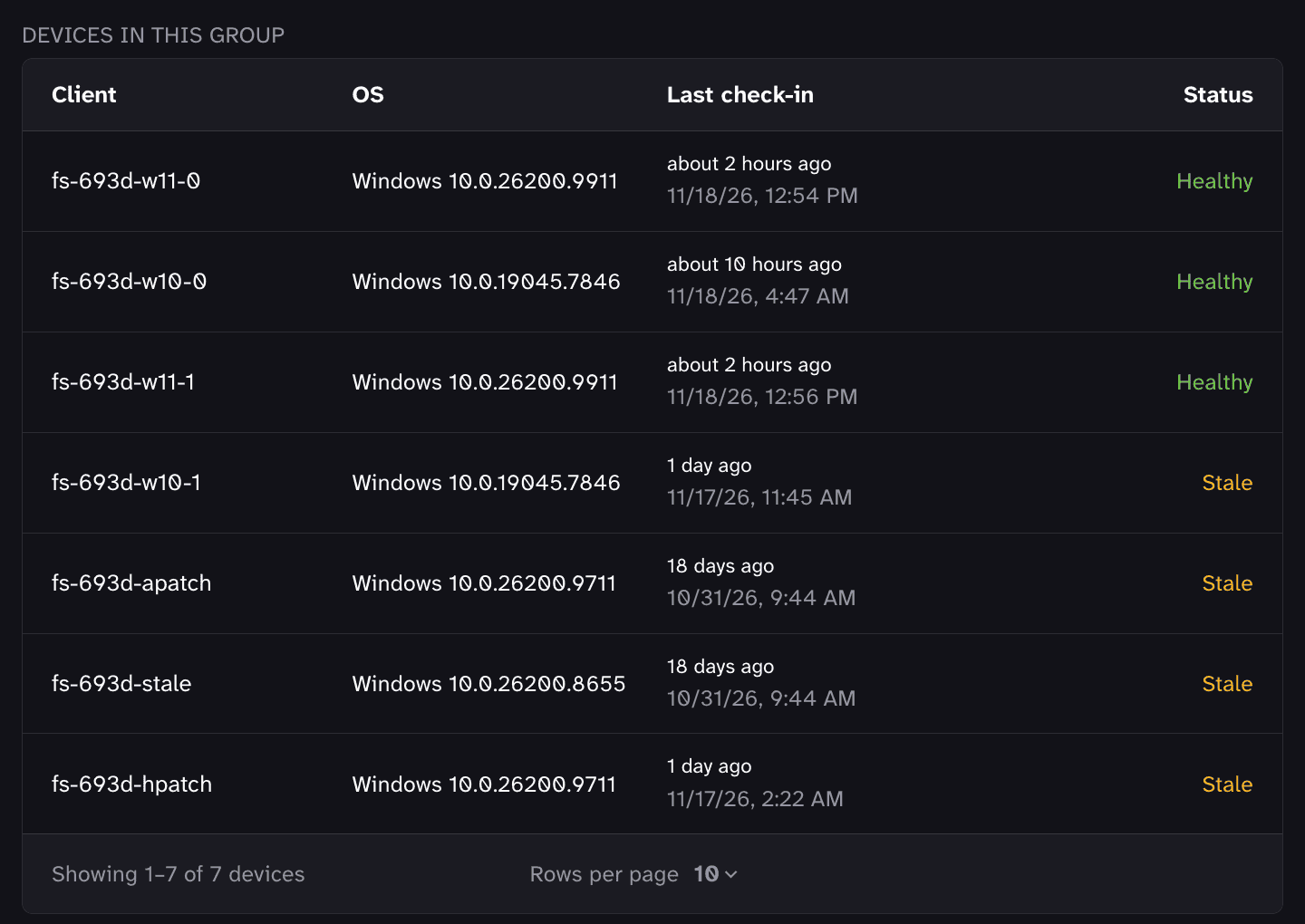
Under Target host group, search for the host group to scan and select it. The Devices in this group table lists the group's devices with their OS, last check-in, and readiness. A readiness badge marks a device that probably won't run the scan. Hover over a badge for details. Not every tool reports every badge.
- Stale check-in: The device hasn't checked in with the tool within its normal cadence, or the tool reports it offline.
- Not answering recent scans: The device didn't answer at least two of the group's last three fleet scans and hasn't answered since. Mondoo still includes it in scans.
- Membership pending: The device's record still names the group, but the group's membership no longer includes it, because a dynamic group rule now excludes it or it was removed from the group. The device hasn't checked in since. Fleet scans of the group don't target it.
- Not reporting: An earlier fleet scan of the group targeted the device, but the tool no longer lists it in the group. Fleet scans of the group don't target it.
-
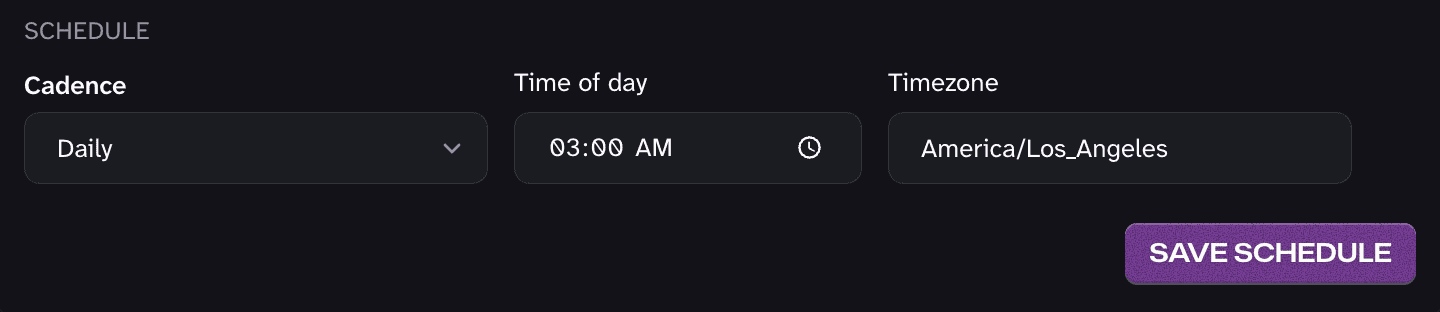
Under Schedule, choose a Cadence. Daily is the default. The cadences offered depend on the tool. Choose Manual only to scan the group once without saving a schedule.
-
For a recurring cadence, set when it runs:
- Day of week (for Weekly) or Day of month (for Monthly, days 1 through 28)
- Time of day (03:00 by default)
- Timezone (your browser's time zone by default)
-
Select Save schedule to save a recurring scan, or Run now if you chose Manual only.
The Saved schedules card lists each schedule with its host group, cadence, time zone, last run, next run, and status. To stop a schedule for a while, select Pause, and select Resume to start it again. To delete it, select Cancel. To change a schedule, save a new one for the same host group: it replaces the old one.
To scan right away without opening the Scan Jobs tab, select RUN at the top of the integration's page. It starts a scan of every host group with an active schedule and leaves the schedules as they are. If the integration has no active schedule, the Mondoo App asks you to turn one on or to start a scan on the Scan Jobs tab. Microsoft Intune integrations have a SYNC button instead of RUN.
Review scan results
The Recent scan jobs card on the Scan Jobs tab lists the scans Mondoo started, with their host group, number of hosts, duration, and status. A scan job's status is Pending, Running, Succeeded, Partial, Failed, Timed out, or Cancelled.
Select a scan job to open its details. The Hosts table shows the outcome on each device, including the reason a device wasn't scanned or its scan failed (for example, the device was offline or didn't check in with the tool in time). If Mondoo retried the hosts a scan couldn't reach in a follow-up scan, the scan detail links to it.
Each device a fleet scan reaches becomes an asset in the space, and its results appear in your inventory like those of any other asset. To open a scanned device's asset page, select Open asset in its row of the Hosts table. If a device's latest fleet scan didn't scan it or failed, the asset page says so and links to the scan.
Check the integration's health
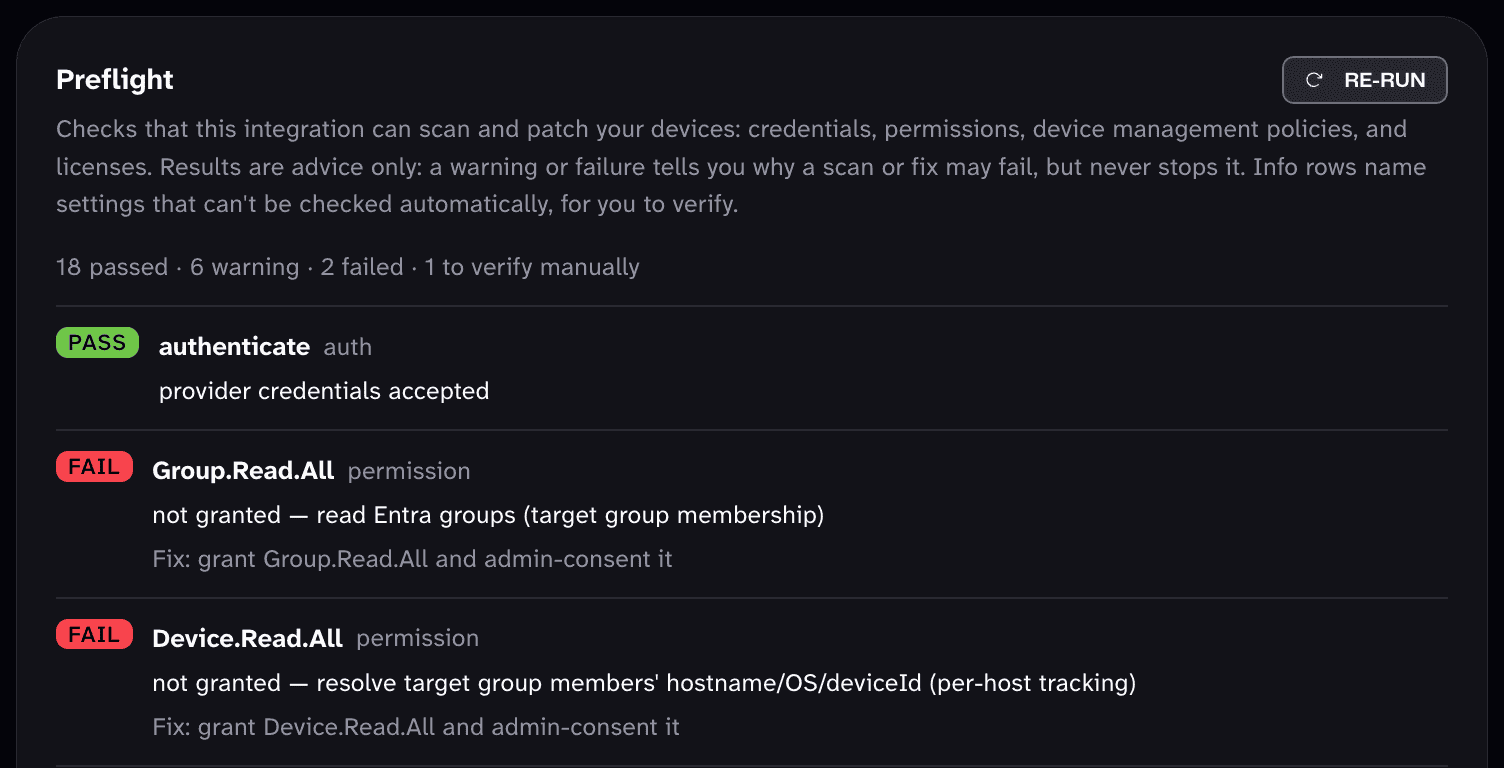
The Diagnosis tab runs preflight checks on the integration: its credentials, permissions, device management policies, and licenses. Each check passes, warns, fails, or lists a setting to verify yourself. The results are advice only: a warning or failure explains why a scan may fail, but never stops a scan. To check again after you fix something, select Re-run.
Set maintenance windows
The Maintenance Windows tab shows the maintenance windows that apply to the integration's devices. A maintenance window says when Mondoo may remediate devices. It never delays a scan. On the tab, you can see the windows imported from the integration or assigned to it, check the effective window for a host group, and, for Microsoft Intune, CrowdStrike Falcon, and opsi, import the windows the tool already defines. To learn more, read Define Maintenance Windows.
Edit or remove the integration
On the integration's page, select the edit (pencil) icon to change its settings, then select Save Changes. To remove the integration, select the trash can icon and confirm.
If the integration authenticates with a stored credential, such as an API client secret or a password, rotate the credential to replace a secret that is expiring or was revoked. In the left navigation, select Settings, then Credentials. Find the credential, open the menu in its Status column, and select Rotate. Every integration that uses the credential switches to the new secret right away. To learn more, read Manage Integration Credentials.
When you edit an Action1 integration, you can change its name, its Region and organization, and which endpoints become assets. The region must be the one the Action1 credential was issued in: scans fail while the two differ. The API credential itself is managed on the credentials page.
Verify the integration
After you save a schedule or start a scan:
- Check the status. On the Integrations page, the integration's status becomes Active once a scan succeeds. To learn what each status means, read Integration Status and Troubleshooting.
- Follow the scan. On the Scan Jobs tab, Recent scan jobs lists the scan with its status. When it finishes, the status is Succeeded, or Partial if some devices weren't scanned.
- Open a scanned device. Select a scan job, then select Open asset in a device's row of the Hosts table to see the device's first results. To learn more, read Review scan results.
- Find devices that weren't scanned. The Hosts table gives the reason for each device the scan skipped or failed on. The Diagnosis tab checks the integration's credentials, permissions, and licenses. To learn more, read Check the integration's health.
Troubleshoot
For errors that all integrations share, read Integration Status and Troubleshooting. The Diagnosis tab also checks the integration's setup.
Action1 refuses to run the scan script
Action1 doesn't run custom scripts for an account that Action1 support hasn't verified, and Mondoo's scans are custom scripts.
Fix: Ask Action1 support to verify your account. Read Before you begin.
The tenant enforces signed automations
Action1 tenants where Endpoint Takeover Prevention enforces signed automations can't run fleet scans.
Fix: Fleet scans aren't available for these tenants. Read Before you begin.
Scans fail after you change the region
The integration's Region must be the one the Action1 credential was issued in. Scans fail while the two differ.
Fix: Select the edit (pencil) icon on the integration page and choose the Region the credential was issued in. Read Edit or remove the integration.
Next steps
- Inventory your assets: find the scanned devices and the vulnerable software on them.
- Define Maintenance Windows: set when Mondoo may remediate the devices.
- Assess and improve your security: review and prioritize the devices' findings.
Last updated on