Find and fix shadow AI on your endpoints
Shadow AI is the unsanctioned AI tooling that employees install without security review: agents, plugins, third-party skills, local models, and the MCP servers that connect them to your systems and data. Mondoo finds it and fixes it, discovering every AI component on your fleet, assessing the risk, and governing what is allowed to run, so security enables AI adoption instead of blocking it.
Agentless rollout through Microsoft Intune or CrowdStrike Falcon.
- claude-codeapproved
- github-copilotapproved
- vercel-labs/agent-browserunapproved
- mcp: prod-dbunknown reach
- deepseek-coder-v2:16bremoved via Microsoft Intune · verified closed
Most AI security tools watch this happen.
Mondoo inventories it, governs what is allowed to run, ships the fix, and verifies it closed.
What is shadow AI, and why is it different from shadow IT?
Shadow IT never acted on its own. Shadow AI does.
These tools run commands, hold credentials, change source code, and reach into internal systems, all from an employee laptop. Many do it through MCP servers, which are the connectors that give an agent access to a database, a repository, or a SaaS account. And this is no longer a developer story. Engineering, HR, sales, and finance are all moving fast on AI, as they should.
The risk is not the speed. It is doing it blind.
of organizations found an AI agent that security or IT did not know about in the past year (Cloud Security Alliance, 2026)
had an AI agent security incident in the past year (Cloud Security Alliance, 2026)
of organizations felt ready to deploy agentic AI securely (Cisco State of AI Security 2026)
of the 58,000+ AI agent skills Mondoo has scanned come back fully clean (Mondoo AI Skills Check, live data)
The research behind these figures, and the full governance framework, is in our shadow AI whitepaper.
A list of the AI tools you approved is not an inventory. An inventory includes
the ones you did not.
Can you answer these today?
Why is the endpoint the AI control plane?
A developer installs a coding agent on Monday. By Friday it has three third-party skills loaded, a connector to the production database, and read access to every credential on the laptop. None of that required a download anyone would question, and none of it shows up as suspicious network traffic.
The endpoint is where AI risk actually lives, because that is where AI tooling gets installed, configured, and given access. Browser, network and identity tools each watch a single point of traffic and judge what passes through it. What they cannot tell you is what is actually sitting on the machine and how it is set up, and that is what decides what AI can do and what it can reach.
No traffic-based tool can tell you which skills are sitting on a finance analyst's laptop, or which connector on a developer's machine holds a production credential. An agent that has not made a single network call yet is still a risk, and the only place it shows up is on the device itself.
That is also why governance has to happen here. A policy can only be enforced against things you know exist, so an incomplete inventory quietly lets everything it missed through. Visibility is the prerequisite for policy, not a nice-to-have beside it.
How do you detect shadow AI across a fleet?
You detect shadow AI by inventorying the installed state of every endpoint rather than watching network traffic. Mondoo discovers your entire AI estate from the endpoints themselves, assesses what it finds, and governs what is allowed to run.
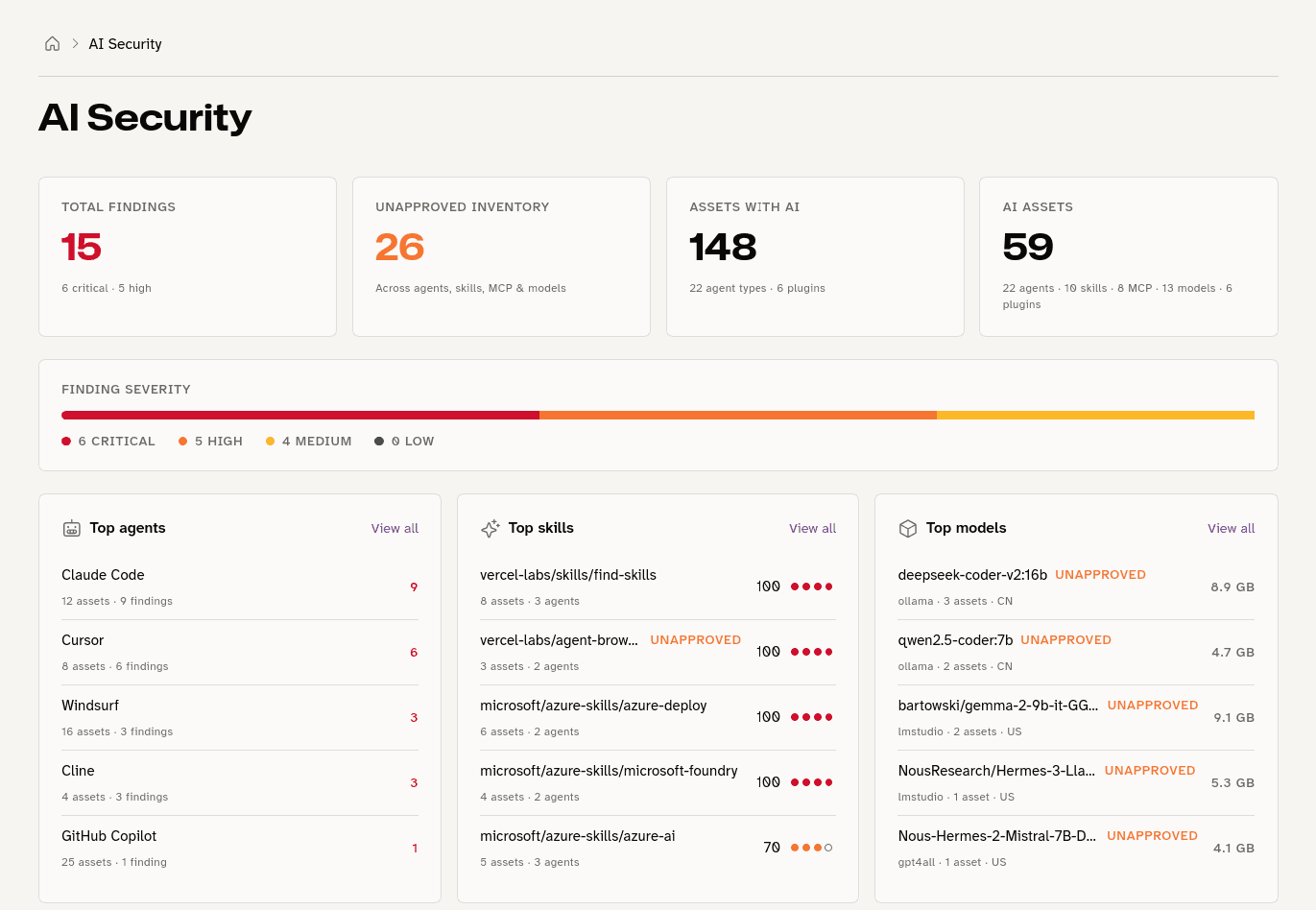
Dangerous AI software
Some AI tools are useful and alarming in equal measure. Take OpenClaw: an autonomous daemon, meaning a program that runs continuously in the background with nobody driving it. It reaches deeper into a system than most of the people installing it realize. Mondoo detects tools like it across your devices and gives you the choice, govern the configuration or remove it entirely.
Vulnerable AI agents
AI agents are software. Outdated versions, dangerous modes, and risky configurations are vulnerabilities like any other, and they belong in the program you already run. Mondoo checks agent versions against known CVEs and agent configurations against best practice, then files the findings next to your existing ones.
Malicious and vulnerable skills
This is where Mondoo is different. We fully evaluate skills using proprietary AI techniques, grounded in Google DeepMind's published AI Agent Traps research, detecting prompt injection, credential theft, hidden instructions, and behavior that does not match what a skill claims to do. It is the same intelligence behind Mondoo AI Skills Check, applied continuously to every skill you have installed.
What your AI tools can reach
Visibility into tools is half the picture. The other half is reach. Mondoo collects access data across your AI tooling and builds the full map: what each agent can touch, which MCP servers expose production systems, and which keys and credentials are in use.
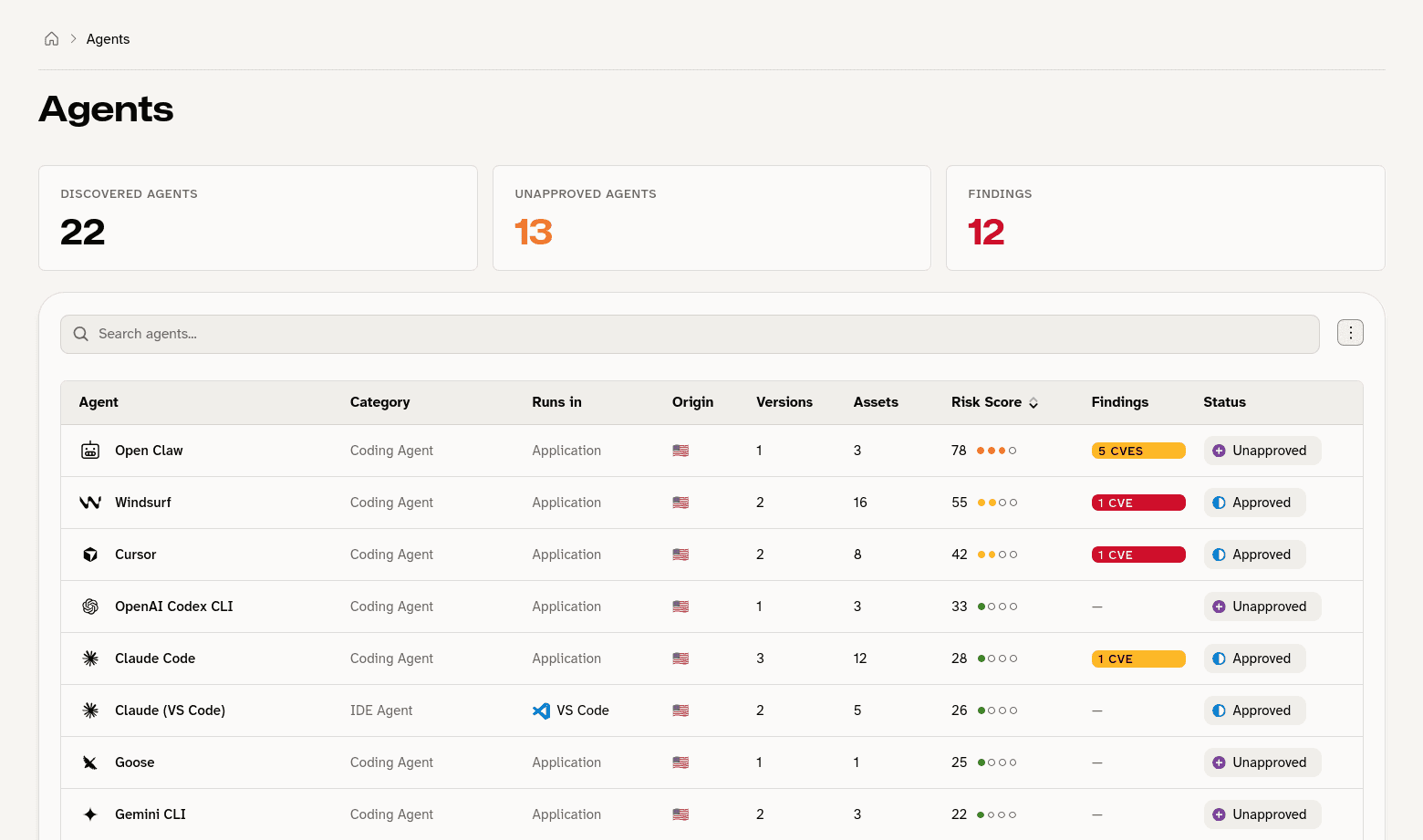
Vulnerable AI agents
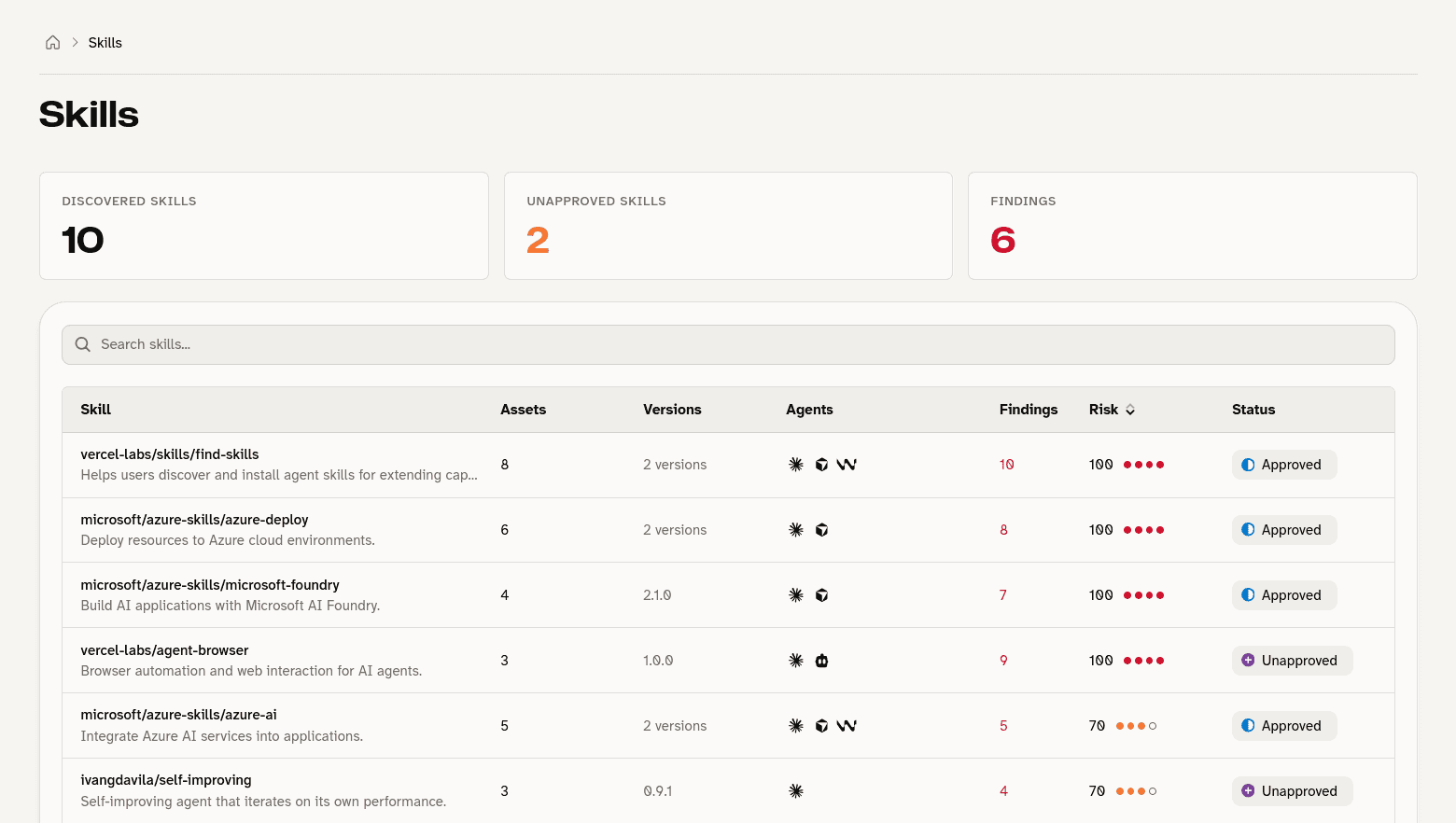
Malicious and vulnerable skills
AI agent governance
AI agent governance means deciding which AI agents, skills, MCP servers, and models are allowed to run on company devices. Then enforcing that decision continuously, against a live inventory rather than a document. You set the policy. Mondoo applies it across every device and flags anything outside approved use, without slowing adoption down.
MCP server security
Model Context Protocol (MCP) servers are how agents reach your tools and data, which makes them the highest-consequence entries in the inventory. One misconfigured MCP server can hand an agent production database access. Mondoo discovers every configured MCP server on every endpoint, maps what each one can actually reach, and flags the ones exposing production systems or holding credentials they should not.
How Mondoo closes the loop
Shadow AI findings run the same loop as everything else Mondoo manages. Detect, prioritize, ship, verify.
Some tools wait for an AI agent to misbehave and then react. Mondoo governs the installed state before anything executes: malicious skills never run, banned agents never operate, and unapproved models never touch company data.
That is the difference between a scanner and a service:
We sell the fix, not the finding.
Detect
Mondoo generates your AI bill of materials from the endpoints themselves: every installed agent, browser and coding tool plugin, configured MCP server, skill, and model. Connect your existing Microsoft Intune or CrowdStrike Falcon deployment and discovery starts from there, with no new endpoint agent to install.
Prioritize
Every component is assessed continuously. Skills evaluated for malicious behavior, agent configurations against best practice, versions against known vulnerabilities, then overlaid with your own policy. Ranked by business impact and exploitability, in the same queue as your CVEs.
Ship
the step others skipFindings close through the tools your team already operates. Remove unauthorized agents, disable risky skills, and correct dangerous configurations at fleet scale, through Microsoft Intune and CrowdStrike Falcon.
Verify
Fixes are re-checked and held closed. Policy keeps enforcing after the ticket shuts, so the same unapproved agent does not quietly reappear on forty machines next quarter.
Are AI agent skills safe to install?
Often they are not. Independent research in early 2026 found more than one in four publicly available skills carries at least one security vulnerability. One campaign pushed 341 malicious skills to a single registry in three days.
Mondoo AI Skills Check is free and agent-agnostic, and it runs on the same intelligence that assesses every skill you have installed in the platform.
This is still vulnerability management
You do not need a new program, a new console, or another agent on the endpoint. The AI-BOM extends the inventory you already maintain. AI findings land next to your CVEs, prioritized the same way, and remediation flows through the ITSM and endpoint management integrations you already use.
One inventory.
One risk score.
One loop.
- 60%
- fewer vulnerabilities reaching production
- <16d
- MTTR for critical issues
- 10x
- faster remediation
- 300+
- customers, including Deutsche Telekom
Where it fits
You are here: shadow AI is one class of exposure inside a wider program, and it sits under Mondoo's AI security umbrella. Agentic vulnerability management closes the exposures on assets you already know about. Attack surface management shows what an attacker can reach from outside. Continuous threat exposure management is the operating model that keeps prioritizing and closing all of it over time.
Frequently asked questions
What is shadow AI?
Shadow AI is unsanctioned AI tooling adopted by employees without security review: agents, plugins, MCP servers, skills, and models. Unlike traditional shadow IT, shadow AI acts on its own. It executes commands, holds credentials, and reaches into internal systems with the user's access.
How do you detect shadow AI?
By inventorying installed state rather than watching traffic: binaries, plugins, skills directories, MCP server configurations, and model artifacts on each machine. Mondoo does this automatically across the fleet, with agentless rollout through Microsoft Intune or CrowdStrike Falcon.
What is an AI-BOM (AI bill of materials)?
An AI-BOM is a continuously updated inventory of every AI agent, plugin, MCP server, skill, and model across an organization's fleet, collected directly from the endpoints. It is the AI equivalent of an SBOM and the foundation for any AI governance policy.
What are MCP server security risks?
Model Context Protocol (MCP) servers connect AI agents to tools and data. A misconfigured or malicious MCP server can expose production systems, leak credentials, or inject instructions into an agent. Governing which MCP servers may exist, and what they may reach, is a core part of AI governance.
What is AI agent governance?
AI agent governance is the practice of defining which AI agents, skills, MCP servers, and models are allowed to run on company devices, and which are not, then enforcing that definition continuously against a live inventory, with remediation for anything outside approved use. It requires a complete inventory first, because a policy can only be enforced against things you know exist.
How does Mondoo evaluate AI skills?
With proprietary AI techniques grounded in Google DeepMind's published AI Agent Traps research, mapping findings to a six-class threat taxonomy and the OWASP Top 10 for LLM Applications.
What are the security risks of AI agents?
AI agents inherit the access of whoever runs them, act with limited human review between checkpoints, and are extensible by third-party code through skills, plugins, and MCP servers. That combination means an outdated, misconfigured, or maliciously extended agent can reach production systems using legitimate credentials.
How does Mondoo deploy?
Agentless rollout is supported through Microsoft Intune and CrowdStrike Falcon. There is no additional endpoint agent to install. Connect your existing deployment and discovery starts automatically.
Is this different from tools that monitor AI agent behavior?
Yes. Those tools observe an agent once it is already operating and react to what it does. Mondoo governs the installed state beforehand: inventory, policy, and remediation, so risky tooling never operates at all.
Does securing AI slow down AI adoption?
It should not. Governance replaces blanket bans, which fail anyway because employees route around them. Teams keep adopting AI at full speed, and security knows exactly what is running, what it can reach, and that it is within policy.
Do I need a separate product or subscription for this?
No. This is vulnerability management extended to your AI estate. AI findings arrive in the same platform, the same queue, and the same remediation workflow as the rest of your exposures.
Take control of your AI estate
- An enterprise-wide AI-BOM from your first scan
- Governance before a skill ever reaches an agent
- Remediation through Microsoft Intune and CrowdStrike Falcon