
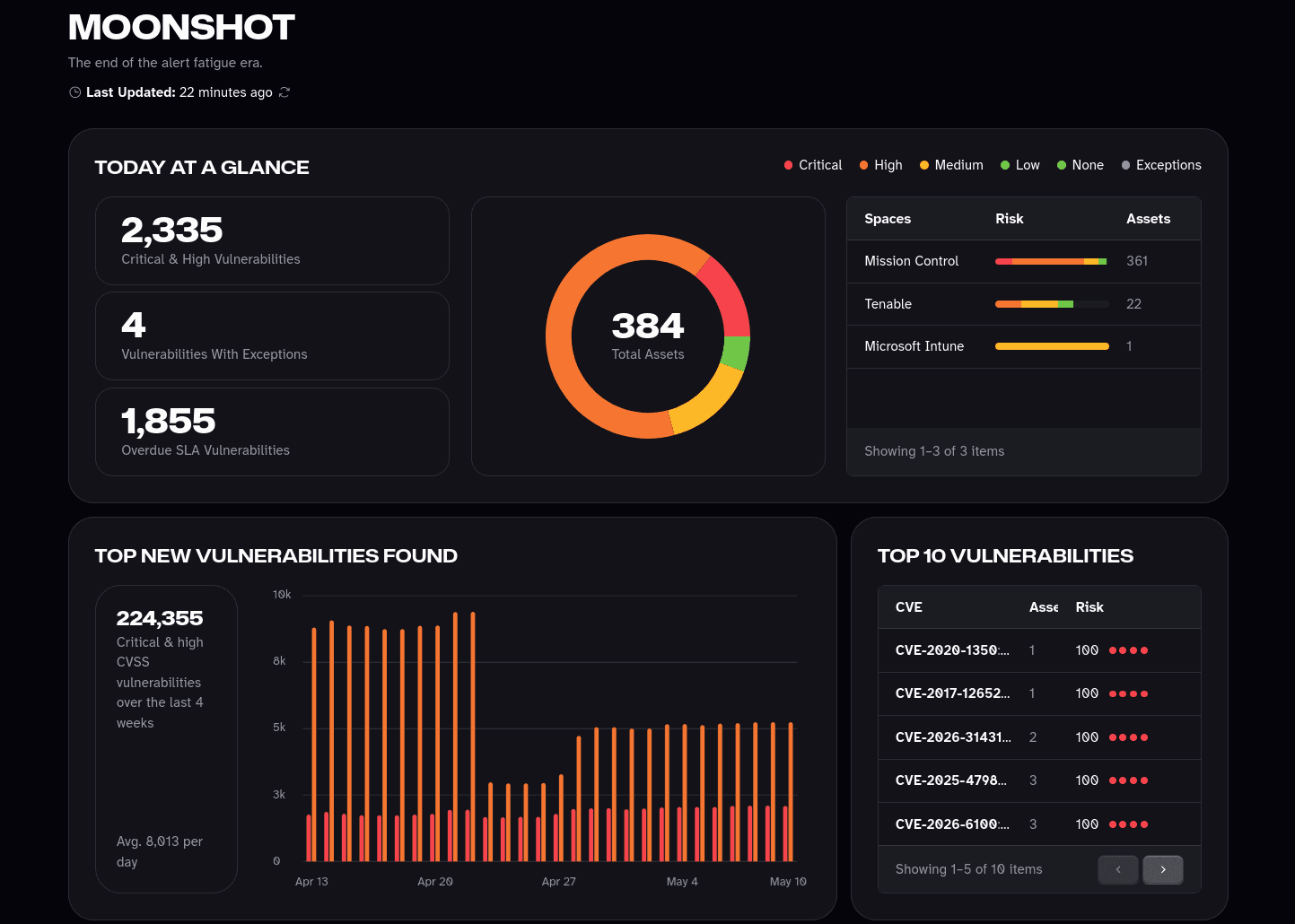
Vulnerability management platforms love to count findings. Our users don't measure success that way. They measure it by what got fixed this week, what didn't, and why. That's the work, and that's what the new Mondoo UI is built around.
Starting today, every Mondoo user is invited into a new Mondoo App: A redesigned, faster, more accessible experience that puts prioritization, operational context, and progress at the center. It's the foundation we needed for the agentic capabilities coming next - and on its own, it already changes how teams move from "we know about this risk" to "this risk is gone."
A modern interface, ready for what's next
The first thing you'll notice is the look. Higher contrast, better colors, denser information without feeling crowded - and a typography and component system that finally meets accessibility standards across the product.
The bigger change is underneath. The UI has been rebuilt on a new component framework so we can move faster on the experiences our users have been asking for, and so we have the right surfaces to plug in the agentic workflows coming next.
Risk Dimensions: Prioritization you can actually explain
For a long time, Mondoo's risk score did a good job ranking findings, but it asked you to trust it. It was hard to understand how we got to the number. Users told us they wanted something they could look at, understand in seconds, and defend in a meeting. That's Risk Dimensions.

Every finding is now scored across five dimensions that matter for real-world prioritization:
- Business criticality - how important the asset is to your organization
- Attack surface - where and how an attacker can reach it
- Blast radius - what else is impacted if this is exploited
- Exploitability - whether there's a known exploit, weaponized PoC, or active campaign already
- News - whether there is public attention and threat actors on this finding
The result is a ranking system you can read like a sentence: This is high risk because it's internet-facing, on a production asset, with an exploit in the wild. You see what matters, and you understand why.

We'll go deeper on Risk Dimensions (and why they outperform single-score models) in a follow-up post this week. Stay tuned.
Operational context: Knowing what it takes to fix
Prioritization tells you what to fix first. Remediation tells you what it takes. Mondoo now surfaces the operational signals teams need before they touch a system:
- Does the fix require a restart?
- Is there a clean rollback path, or do you need a backup first?
- How risky is the patch or version bump?
- Which services and dependencies are impacted downstream?
These are just a few of the questions that decide whether a finding gets fixed this sprint or collects dust in your backlog. Putting that context next to the finding - instead of in a runbook, a wiki, or someone's head - is why we see our users remediate more findings than others.

Dashboards and reporting, rebuilt
Every dashboard in Mondoo has been overhauled. The new organization dashboard tells you something useful at a glance: Where your risk is concentrated, what's improving, what isn't, and what to look at next.
We also rebuilt executive reporting around how teams actually use it. Most leaders don't want to drown in stats, they want to say "here's where we are, here's the trend, here's what we're doing about it." The new reports are designed to drop straight into that conversation, without an analyst stitching screenshots together the day before the meeting. Are we fixing the important risks that put us in danger? Are we getting better at it?

Search and filtering that keep up with real environments
When you have tens of thousands of assets and hundreds of thousands of findings, the difference between a useful platform and a frustrating one is whether you can find the thing in front of you. Search is faster and more forgiving, filters are richer and easier to combine, and lists across the product carry more information per row - so you spend less time clicking and more time deciding.

A soft migration - and a date
When you next log in, you'll see a banner inviting you into the new UI. The previous UI stays available under its current link for now, so teams can switch on their own timeline.
On August 3, 2026, the new UI becomes the only UI. We'll redirect the old link to the new experience at that point.
In the upcoming months, if you run into anything - a workflow you can't find, behavior that feels off, a regression we missed - please tell us. Reach out to your customer success contact, or email support@mondoo.com. We read everything, and the next few weeks are exactly when that feedback has the most leverage.
This release is the foundation for what's coming next. We can't wait to show you the rest.