
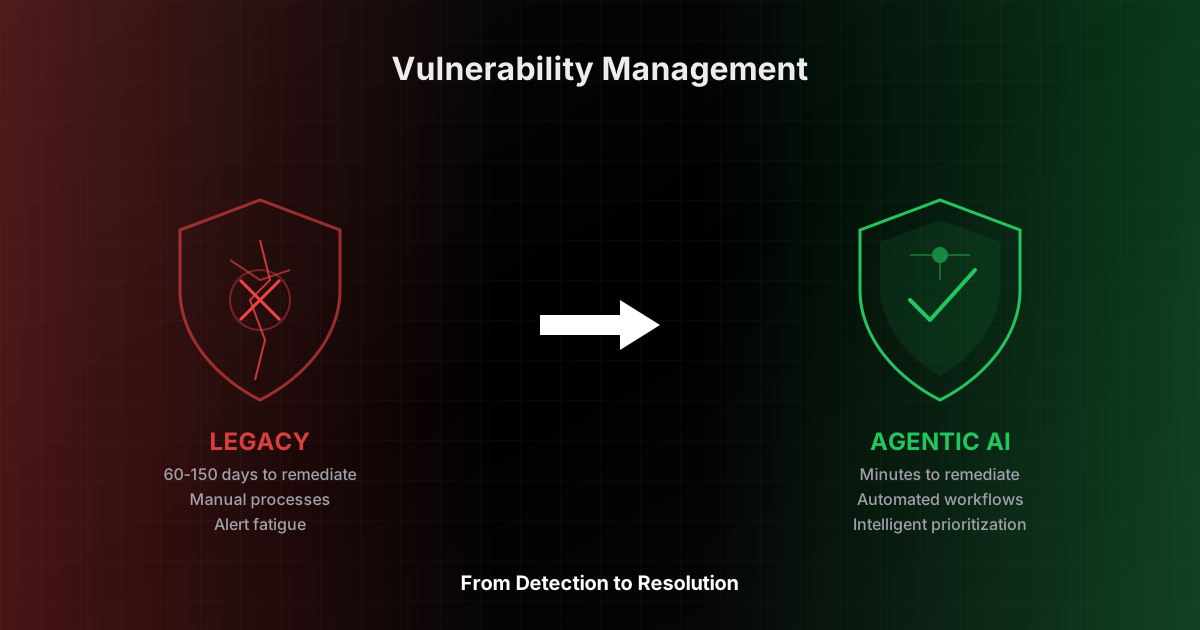
Security teams have never faced more pressure. Attack surfaces are expanding. Adversaries are weaponizing vulnerabilities within hours of public disclosure. Something is fundamentally broken, and it is exposing organizations to significant and prolonged risk.
"Organizations still take between 60 to 150 days to remediate a known vulnerability."
The culprit? Legacy vulnerability scanners that were designed for a different era, ones without cloud-native infrastructure, ephemeral containers, CI/CD pipelines, and sprawling SaaS ecosystems. Tools like Tenable, Qualys, and Rapid7 have been built on foundations laid over the past two decades. While they've bolted on cloud features and AI buzzwords, their core architecture remains rooted in a 'find it, report it, forget it' model that leaves security teams with human-powered, spreadsheet-driven manual triage processes buried under alerts and technical debt.
It's time for a different approach. One where security doesn't end at detection, it extends to remediation that protects. Welcome to Agentic Vulnerability Management.
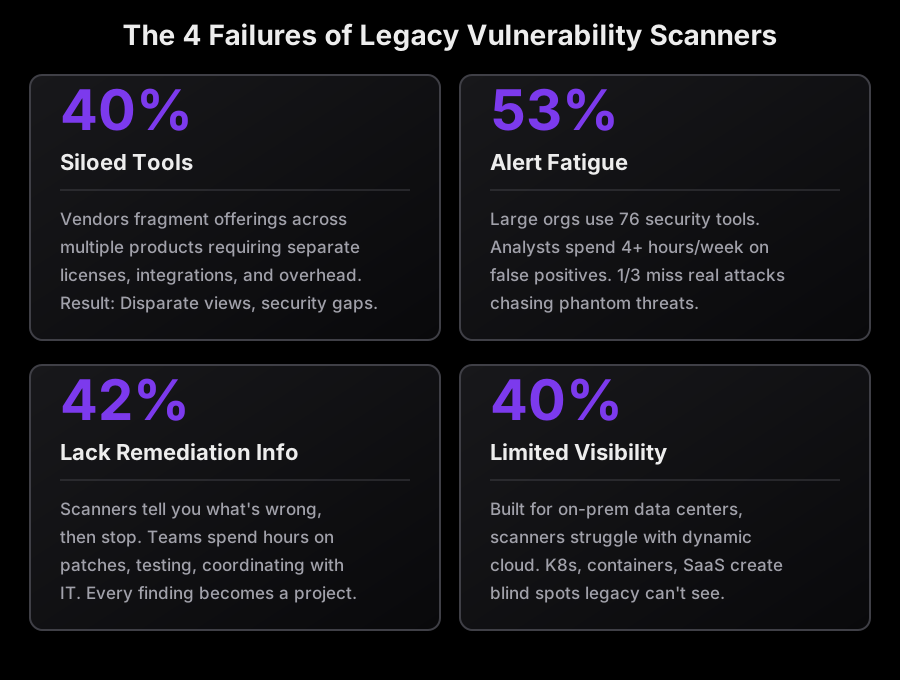
The 4 Failures of Legacy Vulnerability Scanners
Mondoo's 2025 State of Vulnerability Remediation Report revealed the pain points security teams face with traditional tools2,3,4,5,6,7. The numbers paint a damning picture:
'Find and Report' is No Longer Enough
Here's the uncomfortable truth: vulnerability scanning has become a commodity. Every major vendor can identify CVEs. The value isn't in detection anymore, it's in what happens next.
Traditional vulnerability management treats security as a reporting function. Scanners generate PDF reports. Security teams create tickets. IT teams queue patches. Weeks pass. Attackers don't wait for your change management window.
The gap between detection and remediation is where breaches happen. And legacy tools have no answer for it because they were never designed to close that gap. They were built to find vulnerabilities, not fix them.
Legacy Workflows Don't Work (Or Flow)
Let's take a look at what vulnerability management looks like using traditional scanners:
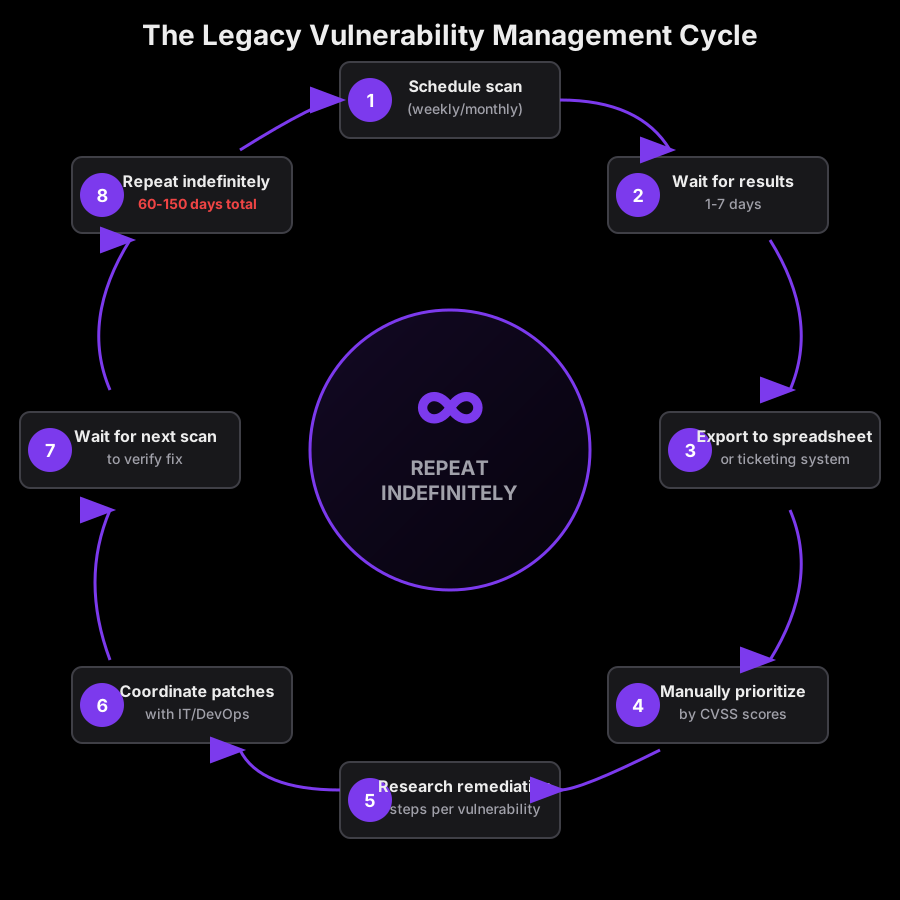
| Step | Action | Typical Time |
|---|---|---|
| 1 | Schedule scan (weekly/monthly to avoid performance impact) | — |
| 2 | Wait for results | 1-7 days |
| 3 | Export to spreadsheet or ticketing system | 1-2 hours |
| 4 | Manually prioritize by CVSS (no business context) | 2-4 hours |
| 5 | Research remediation steps per vulnerability | 30-60 min each |
| 6 | Coordinate with IT/DevOps for patch scheduling | Days to weeks |
| 7 | Wait for the following scan to verify the fix | 1-4 weeks |
| 8 | Repeat indefinitely | ∞ |
Total time from detection to verified remediation: 60-150 days. Yet, attackers weaponize vulnerabilities in hours. The math doesn't work, leaving you massively exposed. This process is slow, error-prone, and doesn't scale. Mean Time to Remediate (MTTR) balloons to months while attackers operate in hours8. The math simply doesn't work in the defenders' favor.
"Traditional vulnerability management is broken. Agentic AI changes everything."
The Architecture Problem: Bolted-On vs. Built-In
When legacy vendors talk about AI and automation, they're describing features layered on top of 20-year-old architectures. Tenable's VPR scoring, Qualys' TruRisk, and Rapid7's Real Risk are all attempts to add intelligence to fundamentally dumb systems.
Legacy Vendors like these aren't unaware of their problems. They've added 'AI-powered prioritization' and 'automated workflows' to their marketing messages. So why doesn't it work? Because the fundamental architecture inhibits it.
Architecture debt is real. These platforms were built on dated scanning models designed for static data centers. Retrofitting them for cloud-native, ephemeral infrastructure means layering abstraction on top of abstraction. Every new capability increases complexity rather than reducing it. That is also the reason why they built different products for each infrastructure and bolt them together in a 'marchitecture'.
This then drives business model misalignment. Legacy vendors monetize through module sprawl and separate license SKUs for VM, container, and cloud security, and web app scanning. Unifying their platform would cannibalize existing revenue streams. They're structurally incentivized to keep things fragmented, and costly.
But you can't bolt-on your way to modern security. Legacy platforms still:
- Rely on scheduled scans rather than continuous, real-time monitoring
- Operate through configuration-based policies instead of policy as code
- Require security team expertise to interpret and act on findings
- Treat cloud, container, and on-prem environments as separate problems
- Leave remediation entirely to human operators
Such architectures were designed when infrastructure was static, deployments were infrequent, and security was a gatekeeper function at the end of the development cycle. That world no longer exists. Today, security must be an intrinsic element across the software development lifecycle, and its infrastructure autoscale on demand. Modern infrastructure demands modern architecture: cloud-native platforms built from the ground up for how organizations actually operate today.
Remediation is a Different Game
Vulnerability detection is a security problem. Remediation and patching is principally an infrastructure automation problem. Legacy vendors have security expertise but limited depth in infrastructure-as-code, CI/CD integration, and platform engineering workflows. You can't hire your way out of a 20-year architectural gap. This isn't a criticism of legacy vendors or their teams. It's simply the recognition that incumbent architecture creates incumbent structural limitations. Remediation requires a different DNA.
It is a common pitfall in the modern security landscape to mistake vulnerability detection for the ultimate solution. Admiring the problem gets you nowhere; true security resilience requires a fundamental shift toward effective remediation, which operates with a profoundly different DNA. While vulnerability detection is primarily a security problem, remediation is fundamentally an infrastructure automation challenge.
"Vulnerability detection is primarily a security problem, remediation is fundamentally an infrastructure automation challenge."
This distinction is where many established, or legacy security vendors face an insurmountable architectural chasm. These incumbents possess deep, domain-specific security expertise - they excel at identifying threats and vulnerabilities. However, their depth of knowledge in the modern, velocity-driven world of infrastructure-as-code (IaC), CI/CD pipeline integration, and contemporary platform engineering workflows is often critically limited.
Remediation in today's cloud-native, agile environments is not a series of manual tickets or 'patch-and-pray' operations. It necessitates an automation-first mindset, which requires tools and platforms native to the development and operations ecosystem. It demands the ability to automatically generate, test, and deploy infrastructure changes as code at scale and at speed.
The reality is that legacy vendors cannot simply 'hire their way out' of a 20-year architectural gap. This isn't a mere skills shortage that can be fixed with a few strategic hires. It is a criticism-free recognition that the incumbent architecture, the very foundation of their products and systems, creates incumbent structural and philosophical limitations. These systems were built for a different era, one where infrastructure was static and change was slow. They lack the native hooks, the API-first design, and the velocity required to operate as an integral part of a modern, automated remediation loop. To effectively bridge the gap between detection and fix, a platform must speak the language of infrastructure, not just the language of security reports.
Enter Agentic AI: From Detection to Resolution
Agentic AI represents a fundamental shift in how security operates. Unlike traditional AI that processes prompts and returns outputs, agentic systems act autonomously, planning tasks, making decisions, and taking actions without constant human oversight.
"62% of organizations are already experimenting with AI agents, and by 2028, one-third of GenAI interactions will involve autonomous agents."
In vulnerability management, this means AI agents that don't just identify problems but actually solve them. The difference is truly transformative:
Continuous discovery, not periodic scanning. Agentic systems monitor environments in real-time, detecting vulnerabilities as they emerge rather than waiting for the following scheduled scan. When a new CVE drops, you know immediately which systems are affected.
Intelligent prioritization with business context. Instead of drowning teams in CVSS-ordered lists, AI agents filter noise and surface only critical issues based on actual exploitability, asset criticality, and business impact. A vulnerable development server doesn't get the same priority as an exposed production database.
Autonomous remediation. This is where the paradigm truly shifts. Agentic AI doesn't just tell you a server needs a patch; it generates the fix, tests it safely, and can deploy it automatically or with one-click approval. The entire workflow from detection to resolution happens at machine speed.
Closed-loop verification. After remediation, the system automatically validates that the fix worked and updates the security posture accordingly. No more waiting for the following scan to confirm you've actually solved the problem.
It's no surprise that 71% of security leaders now consider continuous threat exposure management essential to improving metrics like MTTR10.
Agentic AI Vulnerability Management in Practice
Imagine a different workflow, one that works:
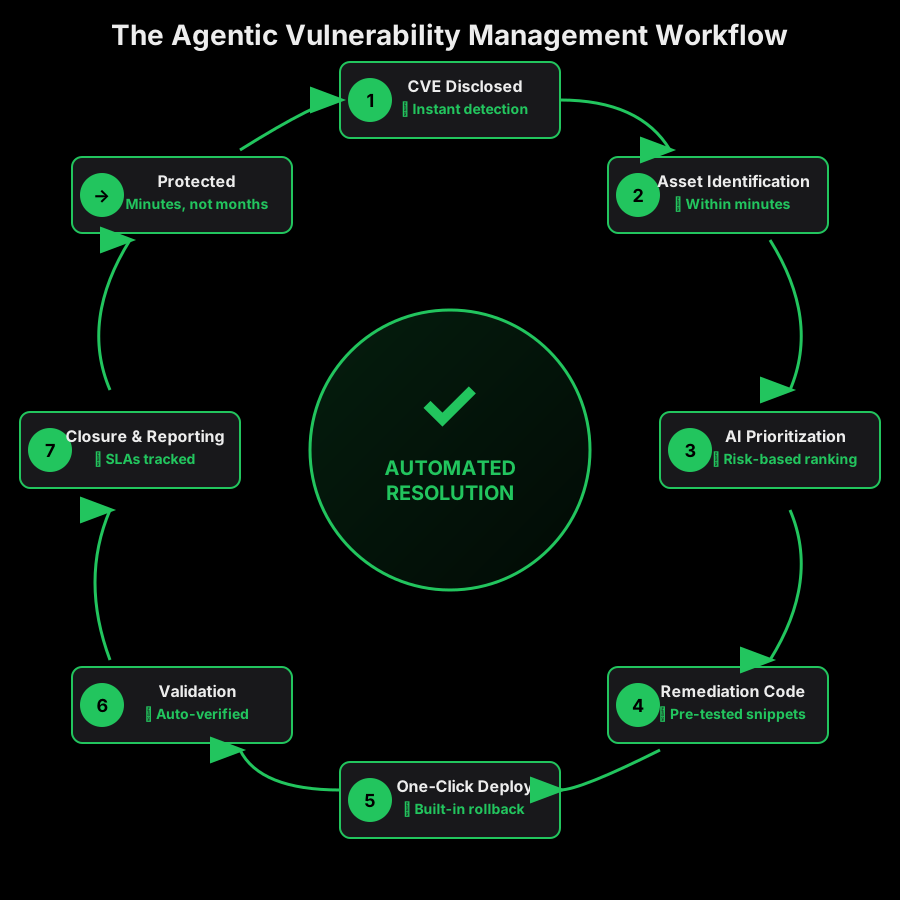
| Step | Action | Typical Time |
|---|---|---|
| 1 | New critical vulnerability disclosed | — |
| 2 | Platform identifies every affected asset (cloud, on-prem, SaaS) | Minutes |
| 3 | AI prioritizes based on exposure, exploitability, business impact | Automatic |
| 4 | Pre-tested remediation code generated (Ansible, Terraform, Intune, bash, powershell) | Automatic |
| 5 | One-click deployment with built-in rollback | Minutes |
| 6 | System validates remediation, updates posture | Automatic |
| 7 | Tickets closed, SLAs tracked, compliance reports generated | Automatic |
This isn't theoretical. Organizations using this approach have achieved 60% reduction in vulnerabilities, MTTR under 16 days, and 10x faster remediation than with manual processes11. The key differences from legacy approaches:
Unified platform vs. tool sprawl. One console covering cloud infrastructure, Kubernetes, containers, CI/CD pipelines, SaaS applications, and endpoints. No more stitching together data from disparate systems.
AI-native vs. AI-adjacent. Intelligence is built into the core architecture, not bolted on as an afterthought. The system was designed from day one to leverage AI for prioritization, correlation, and autonomous action.
Policy as code vs. configuration-based. Security policies are defined as code that can be version-controlled, tested, and deployed alongside infrastructure. Shift-left security that prevents vulnerabilities from recurring.
Transparent and open vs. proprietary black boxes. Open source foundations that let engineers see precisely what's happening. No magic, just well-engineered automation that builds trust.
Building Resilience: Why Change is Non-Negotiable
Security leaders increasingly recognize that their current tools aren't working. The metrics tell the story:
- MTTR is today measured in months rather than days or hours
- Security teams are spending more time triaging than remediating
- Compliance audits that reveal the same unpatched systems quarter after quarter
- DevOps teams frustrated by security bottlenecks
- Growing vulnerability backlogs that never shrink
The cost isn't just operational, it's existential. Every day a critical vulnerability remains unpatched is a day attackers can exploit it. And when breaches happen, the business consequences extend far beyond the security team: revenue loss, brand damage, regulatory penalties, and in some cases, existential threats to the organization.
The alternative is clear. Modern Agentic Vulnerability Management:
- Reduces friction between security and platform engineering by providing actionable fixes, not just findings
- Accelerates MTTR from months to days through automation and one-click remediation
- Eliminates alert fatigue through intelligent prioritization that surfaces only what matters
- Improves compliance posture with automated SLA tracking and reporting
- Prevents vulnerability recurrence through shift-left integration in CI/CD pipelines
Making the Transition Work
If your current vulnerability management program feels like a hamster wheel, endless scanning, endless alerts, endless backlog, you're not alone. And you don't have to stay stuck.
The path forward starts with recognizing that the problem isn't your team's effort; it's the tools' architecture. Legacy scanners were built for a world that no longer exists. Continuing to invest in that paradigm means continuing to lose the race against attackers, and extended risk exposure for your organization.
Agentic AI Vulnerability Management replaces a broken workflow with one that actually works, where detection leads directly to resolution, where security enables rather than blocks, and where your team can finally focus on strategic work instead of manual triage.
The question isn't whether to modernize. It's how quickly you can get there and protect your organization.
Ready to see what Agentic Vulnerability Management can do for your organization? Request a demo and experience the difference firsthand.
References
- Infosec Institute and PurpleSec research. 'How To Reduce Your Mean Time To Remediate A Vulnerability,' PurpleSec, 2025.
- Mondoo. '2025 State of Vulnerability Remediation Report,' survey of 125 IT and security professionals. https://mondoo.com/resources/state-of-remediation-2025
- Mondoo. 'Mondoo vs Tenable - Vulnerability Management Comparison.' https://mondoo.com/comparisons/mondoo-vs-tenable
- Mondoo. 'Mondoo vs Qualys - Vulnerability Management Comparison.' https://mondoo.com/comparisons/mondoo-vs-qualys
- Mondoo. 'Mondoo vs Rapid7 - Vulnerability Management Comparison.' https://mondoo.com/comparisons/mondoo-vs-rapid7
- Panaseer research on enterprise security tool usage, cited in 'What is Mean Time to Remediate (MTTR) in Cybersecurity?' Cymulate, 2025.
- VikingCloud research. 'Agentic AI in Cybersecurity: Applications, Benefits, and Real-World Impact,' VikingCloud, 2025.
- Edgescan. '2023 Vulnerability Statistics Report,' finding that Mean Time To Remediation (MTTR) for Critical Severity vulnerabilities is 65 days.
- McKinsey. 'The state of AI in 2025: Agents, innovation, and transformation,' and Gartner. 'Agentic AI for Vendors Is a Risk Without Oversight,' September 2025, cited in Palo Alto Networks, 'Agentic AI Security: What It Is and How to Do It.'
- Cymulate. 'What is Mean Time to Remediate (MTTR) in Cybersecurity?' 2025.
- Mondoo customer outcomes data. https://mondoo.com/why-mondoo